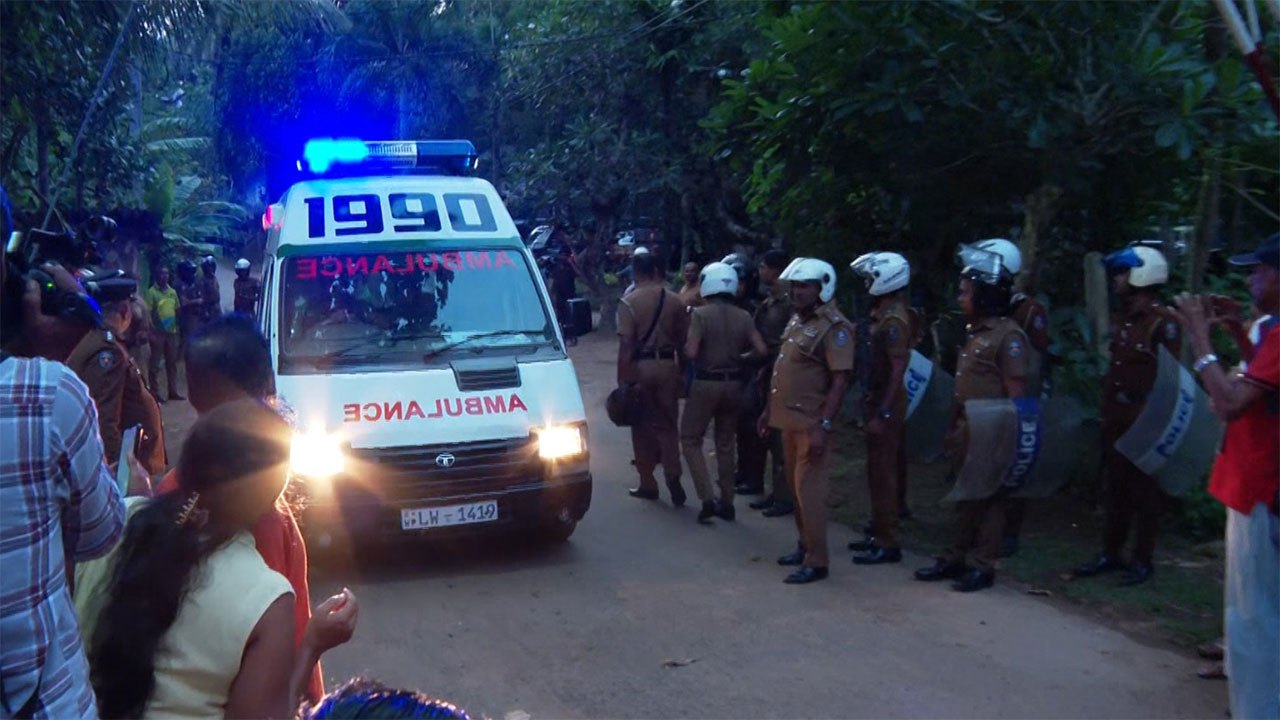
One inmate has died and six other people were injured after unrest broke out at Mahara Prison on Saturday evening, with a fire tearing through a building inside the complex and Special Task Force personnel deployed to its perimeter.
Seven people were taken to the Ragama Teaching Hospital, where one of them later died of his injuries, hospital sources said. Daily Mirror reported all seven as inmates; Ada Derana described the injured as “several persons, including inmates,” leaving open whether prison staff were among them.
The Prisons Department said steps had been taken to bring the situation under control. It had not issued a formal statement on the incident by Saturday evening.
A dispute that escalated into a fire
The unrest was reportedly triggered by a dispute between inmates and prison officers during the afternoon. Prison sources said inmates set fire to the office of the Chief Jailer and to the prison’s Disciplinary Division, and that crews were working to extinguish the blaze.
Sri Lanka Police said several special police teams were sent to assess and manage the situation. Security was tightened around the complex, with police and STF personnel posted outside to prevent any escalation, and additional prison officers were called in.
Justice Minister Harshana Nanayakkara told Hiru News that coordination to contain and settle the situation was being handled through the Commissioner General of Prisons.
Relatives who arrived at the prison during the afternoon for scheduled visits were turned away and were still waiting outside the gates. Several of them told reporters they had heard gunshots coming from within the walls. That account has not been confirmed by police or the Prisons Department.
The second major prison incident in three weeks
The Mahara unrest follows the riot at Negombo Prison on July 12, the deadliest prison incident in recent Sri Lankan history, in which the death toll has since been revised upward to 32 — 10 officers and 22 inmates.
That incident prompted a government review of conditions inside the prison system. Officials have acknowledged severe overcrowding, with the inmate population standing at about 39,000 against a designed capacity far below that figure, and ministers have floated house arrest for some categories of offenders as one way to relieve pressure.
Update (August 1, night): Unrest flared again outside the prison several hours later, prompting police to impose a curfew on the surrounding area and the Air Force to put a helicopter and drones overhead.
Sounds resembling gunfire were heard from inside the complex during the evening, according to Ada Derana and the Daily Mirror. Relatives who had gathered at the gates and residents from the surrounding area then attempted to break through police barricades. Security personnel moved in to disperse the crowd, and some of those present threw stones at officers. Water cannon vehicles were brought to the road in front of the prison.
Police subsequently imposed a curfew with immediate effect and until further notice, confined to three Grama Niladhari divisions within the Ragama Police Division that surround the prison: 246 Kendaliyadda Road–West, 246C Kendaliyadda Road–North and 181G Dambuwa. The police spokesman said the restriction applies only within those divisions.
The Sri Lanka Air Force deployed a Bell 412 helicopter and drones to monitor the situation from the air, its spokesman said. The newly appointed Army Commander arrived at the site during the night to observe conditions and the security operation, the Army Media Unit told Hiru News.
Hiru also reported damage to several parts of the prison, including the inmate registration division and the Chief Jailer’s office, and said police, the Special Task Force and the riot squad had all been called in. Its account of how the disturbance began differs from earlier reports: Hiru said it developed while relatives were at the prison to ask after inmates, when a group of prisoners threw stones out of the complex. Ada Derana and the Daily Mirror had attributed the original afternoon flare-up to a dispute between inmates and prison officers.
The death toll and injury figures were unchanged, with one inmate dead and six others being treated at Ragama Teaching Hospital.
Update (August 2, morning): The unrest has been brought under control and all inmates are confined to their cells, Sri Lanka Police said on Sunday morning. The curfew imposed on the three Grama Niladhari divisions around the prison remains in effect until further notice.
Police said the Army was deployed alongside the Special Task Force and regular police units to restore order, in addition to the Air Force’s aerial monitoring overnight.
Ada Derana’s account resolves the earlier ambiguity over who was hurt: it now states that seven inmates were injured and admitted to Ragama Teaching Hospital, one of whom later died — consistent with the Daily Mirror’s original report that all seven were prisoners.
The report also says inmates set fire to the Chief Jailer’s office and the prison’s disciplinary division, and that the crowd outside built up after relatives who arrived to visit inmates were refused entry.
The death toll remains at one.
The Daily Mirror carried the same account on Sunday morning, confirming that all inmates had been confined to their cells and that the curfew over the surrounding Grama Niladhari divisions remained in force until further notice.
Update (August 2, midday): investigation opened, damage detailed
The Prisons Department has launched an immediate investigation into the unrest, Prisons Spokesperson Commissioner A.C. Gajanayake told reporters on Sunday. He said the cause has not yet been established.
Gajanayake gave the first official account of how the disturbance started, and it differs from both earlier versions. He said a group of inmates tried to breach a section of the prison by attacking a temporary metal-sheet barrier erected around a proposed new administrative building, and also attempted to damage the main gate. The unrest then continued through the night until Sunday morning.
Order was restored by prison officers working jointly with the Police, the Special Task Force and personnel from the Army, Navy and Air Force, he said. Gajanayake appealed to inmates’ relatives to remain calm, and said no decision had been taken on transferring prisoners to other facilities.
He described the damage as extensive. The prison kitchen, including its boilers and cooking equipment, was destroyed and set on fire. The rehabilitation building and its equipment were damaged, as were the prison hospital and the main administrative office — which Ada Derana identified as the Chief Jailer’s Office. Workshops used for inmate rehabilitation programmes, including tailoring and carpentry, were also destroyed.
In a separate report, Ada Derana said inmates destroyed official documents during the unrest and that a group of prisoners attempted to escape during clashes with prison staff overnight. Security forces thwarted several escape attempts, it said. That account has not been confirmed by the Prisons Department.
Namal Rajapaksa calls for prison reform
SLPP national organiser and MP Namal Rajapaksa said the unrest points to institutional failure rather than an isolated incident, in a post on X.
“This is the second major prison disturbance in a matter of weeks. It is no longer an isolated incident. It is the result of poor management, negligence, and a prison system that is under immense strain,” he wrote, asking: “Another prison unrest. How many lives this time?”
Rajapaksa questioned why the Department of Prisons is still operating without a permanently appointed Commissioner General. “Even today, the Department of Prisons continues without a permanently appointed Commissioner General, despite the crisis unfolding before us,” he said.
Deploying additional security personnel might contain immediate tensions but would not address the underlying problems, he argued, citing overcrowding, inadequate facilities, poor healthcare and the absence of meaningful rehabilitation programmes. Imprisonment should deprive people of their liberty but not their dignity, he said, urging the government to move beyond crisis management.
Update (August 2, afternoon): curfew lifted, 104 inmates moved, rights commission opens inquiry
Police lifted the curfew on the three Grama Niladhari divisions around the prison on Sunday afternoon, saying the overall situation had been brought under control. The restriction, imposed the previous night, was withdrawn with immediate effect.
The Department of Prisons said 104 inmates have been transferred out of Mahara to seven other facilities — Dumbara, Welikada, Boossa, Kalutara, Badulla, Polonnaruwa and Batticaloa. Prisons Commissioner (Operations) and Media Spokesman A.C. Gajanayake said a list of the transferred inmates has been posted at the roadblock outside the prison. Mahara Prison Superintendent Rohana Galappaththi said those moved are suspected of involvement in the unrest.
Galappaththi urged relatives not to worry about inmates’ safety, saying security inside the facility has been fully ensured. Accounts differ on how long visits will be suspended: the Superintendent told Ada Derana that family visits will remain suspended until Thursday, while the Department of Prisons told the Daily Mirror and NewsFirst that visits would resume after Monday and Tuesday, with repair work under way on the damaged visitor area.
The Prisons Department said order was restored through a joint operation by prison officers, Sri Lanka Police, the Special Task Force and the Tri-Forces.
A separate human rights inquiry
The Human Rights Commission of Sri Lanka has opened its own special investigation into the unrest, independent of the Prisons Department inquiry. A three-member HRCSL team visited the prison on Sunday and began examining the circumstances that led to the incident and identifying those responsible.
Representatives of the International Human Rights Organization Sri Lanka also visited the site. Its Executive Director, Subashana Subawickrama, said damage running to tens of millions of rupees had been caused and that the facility is not currently in a condition suitable for holding inmates.
He raised the possibility that the destruction was organised rather than spontaneous. “We need to establish whether this happened due to the actions or demands of the inmates, or whether it was carried out for the benefit of another party,” he said. “This is not something that could have been done by a few individuals inside a single room. Given the scale of the destruction, we strongly believe that this may have been the result of a planned act.”
That claim has not been confirmed by the Prisons Department or the police, and no official has publicly supported it.
Political fallout
Opposition Leader Sajith Premadasa used a public rally at Maligakanda to argue that a government unable to manage its prisons cannot rebuild the country, noting that the government had voted down an opposition no-confidence motion against the Minister of Justice and Prisons only days before the unrest.
Update (August 2, evening): damage put above Rs. 150 million
The damage caused to Mahara Prison during the unrest is estimated to exceed Rs. 150 million, Ada Derana reported on Sunday evening, citing reports. The Department of Prisons said its investigation into the cause is continuing.
Several buildings inside the complex sustained extensive structural damage, including destroyed roof tiles. Equipment used for vocational rehabilitation programmes, including sewing machinery, was also damaged. The Daily Mirror, citing the Department of Prisons, listed the rehabilitation division, the visitors’ area, the prison hospital, the kitchen, the industrial section and a number of prison buildings among the facilities affected.
The disturbance ran for more than 13 hours, beginning at around 4.00 p.m. on Saturday and being brought under control by security forces at about 6.00 a.m. on Sunday. Inmates allegedly threw stones from inside the premises until around midnight, and several houses near the prison were damaged in those attacks.
A fuller account of how it unfolded
Police preliminary investigations indicate the unrest was led by four inmates, identified by Ada Derana as “Saathan”, “Asaar”, “Petta” and one other.
According to that account, four inmates climbed onto the prison roof on Saturday morning to protest against the prison administration. A senior prison official who went to hear their grievances was met with stones thrown by inmates. Prison officers subsequently withdrew from the area, first securing medicines from the prison hospital, sharp implements from the kitchen and weapons from the armoury.
Around 1,500 inmates then allegedly tried to escape by breaking through a section of wall that was under construction, and prison officers opened fire to stop them. Another group set fire to a prison building. Some inmates broke into a store holding confiscated narcotics and consumed the drugs, Ada Derana reported.
Inmates also broke the locks on several wards, releasing other prisoners from their cells. Some refused to leave and were assaulted by those taking part in the unrest.
Ada Derana reported that the disturbance may have been triggered by tensions over a shortage of narcotics inside the prison after authorities stepped up efforts to stop drugs circulating in the facility. That account is attributed to reports rather than to a named official, and the Prisons Department has not confirmed a cause.
The report also identified the inmate who died as a 33-year-old resident of Hendala, Wattala, who had been remanded over allegations of motorcycle theft and possession of 20 grams of “ice” methamphetamine.
Justice Minister suspects coordination from outside
Justice Minister Harshana Nanayakkara said the Mahara unrest is fundamentally different in character from the earlier disturbance at Negombo Prison. Speaking to reporters after an event on Sunday afternoon, he said the Negombo incident was a clash between inmates, while Mahara involved a confrontation between inmates and the prison administration.
Nanayakkara said he suspects certain groups may be orchestrating prison unrest from outside in an organised manner, and that authorities would investigate whether there was any external involvement. Such incidents had not previously arisen without apparent cause, he said.
On overcrowding, the minister acknowledged it remains one of the factors contributing to tension inside prisons, but said the problem long predates the current government and that measures are now being taken to address it. He said an investigation would be carried out into the damage to public property and that those responsible for the destruction would face strict legal action.
Prisoners’ rights group blames overcrowding
The Committee for the Protection of Prisoners’ Rights attributed the unrest squarely to overcrowding and accused prison authorities of concealing the real conditions inside the facility.
Its chairman, Attorney-at-Law Senaka Perera, said Mahara Prison has an official capacity of 991 inmates but is currently holding 4,447 — more than four times its design capacity. Ada Derana elsewhere put the prison’s population at more than 4,100. Perera said available facilities cannot meet the needs of that population and that living conditions inside have deteriorated as a result.
Perera also gave a different timeline and a different characterisation of the incident, saying the unrest began at around 1.00 p.m. on Saturday — three hours earlier than the police account — and that prison officials failed to act to contain it, instead withdrawing from the premises and allowing the confrontation to escalate. He described it as a confrontation among inmates, where the Justice Minister described it as one between inmates and the administration.
Neither the Prisons Department nor the police have responded to the committee’s allegations.
Update (August 4): police point to a drug-trafficking dispute
Police now suspect the unrest was triggered by a dispute linked to an alleged drug-trafficking operation inside the prison, NewsFirst reported on Tuesday — a sharper account than the earlier suggestion that tension arose from a shortage of narcotics.
Investigators have identified two inmates, both facing drug-related charges, as allegedly involved in instigating the disturbance. NewsFirst renders their names as “Patta” and “Satan”; they are the same two inmates named in Ada Derana’s earlier account as “Petta” and “Saathan”. Evidence also suggests the involvement of two further inmates.
Statements have been recorded from approximately 25 people, including inmates injured during the unrest, and several teams are continuing inquiries.
The Department of Prisons has decided to appoint a three-member committee to investigate the incident. Acting Commissioner General of Prisons Prasad Hemantha said police and the Special Task Force remain deployed outside the prison while investigations continue.
Investigators gave a fuller account of how the disturbance began. Around four inmates climbed onto a prison roof on Saturday evening without apparent justification, saying from the rooftop that they could no longer remain in the prison. While officers were attempting to bring them down safely, another group of inmates became agitated and began acting aggressively, allegedly trying to break through the main gate and escape.
As the situation escalated, prison authorities sought help from the police and the Special Task Force. Police said inmates repeatedly acted provocatively and set fire to prison property, with the unrest continuing through Saturday night; after midnight a group set fire to the prison kitchen. Police suspect the inmates may have acted according to a pre-planned strategy.
Update (August 5): committee appointed to cost the damage
A second committee has been appointed, this one to assess the damage caused to prison property during the unrest, NewsFirst reported on Wednesday.
Acting Commissioner General of Prisons Prasad Hemantha said inmates damaged several facilities during the disturbance, among them the prison kitchen, the Chief Jailer’s office and the Rehabilitation Division. The committee has been asked to establish the extent of the destruction and to submit urgent recommendations for restoring the affected buildings.
It is separate from the three-member committee appointed to investigate the circumstances of the incident, which Hemantha said has already begun work.
The Department of Prisons said security inside the prison and in the surrounding area has now been fully restored.
NewsFirst put the number hurt in the unrest at eight inmates in addition to the one who died — a higher figure than the six injuries reported when the incident occurred, and than the seven people taken to Ragama Teaching Hospital on the night. The Department of Prisons has not published a consolidated casualty figure.