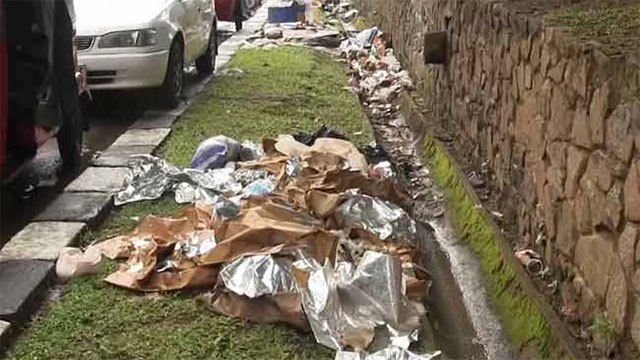
Residents living around the historic Sabaragamuwa Saman Devalaya in Ratnapura have complained that rubbish left behind by the annual Perahera has still not been cleared four days after the pageant ended.
They accuse the Ratnapura Municipal Council of acting irresponsibly in failing to remove the waste, and warn that the delay could contribute to the spread of dengue.
Discarded polythene, plastic bottles, cups and other non-biodegradable rubbish are scattered across the premises. The area has had heavy rain in recent days, and rainwater is now collecting in the containers left lying on the ground — the standing-water conditions in which Aedes mosquitoes breed.
The site is not a marginal one for dengue risk. According to the municipal council’s own health authorities, the area has already been identified as a high-risk dengue zone.
Residents also say the main drainage system within the Devalaya premises has become blocked with polythene, plastic and other waste, and have called on the authorities to clear the rubbish before it becomes a more serious public health problem.
Why the timing matters
The complaint lands in the middle of Sri Lanka’s worst dengue year on record. The Health Ministry reported this week that the national case count for 2026 has passed 85,000, although weekly cases fell about 18 per cent in the most recent reporting period — the first sustained decline in months.
Waste left after large religious gatherings is a recognised weak point in that effort. Control campaigns this year have repeatedly targeted illegal dumping and uncollected refuse as breeding grounds, including a waste management drive in Puttalam framed explicitly as dengue prevention, and enforcement action against premises where larvae are found.
The Ratnapura Municipal Council had not publicly responded to the residents’ allegations at the time of writing.