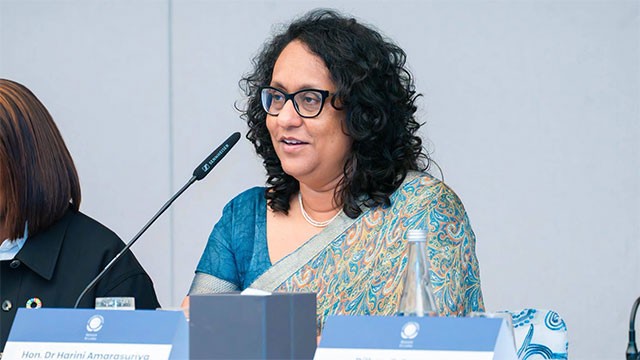
Sri Lanka’s doors remain open to transparent, long-term investment, and the government is prepared to give maximum support to businesses that uphold human rights, protect the environment and contribute to equitable growth, Prime Minister Dr. Harini Amarasuriya has said.
She was addressing the Asia-Pacific SDG Investment Forum in Colombo, organised by the United Nations Global Compact and the Board of Investment of Sri Lanka under the theme “Forward Faster Now.”
Achieving the Sustainable Development Goals would require close cooperation between governments, businesses and civil society, the Prime Minister said. Developing countries face an annual financing gap of between US$2.5 trillion and US$4 trillion, she noted, with the shortfall in the Asia-Pacific region alone standing at around US$1.5 trillion. The region also risks falling short on 88% of measurable SDG targets by 2030.
Growth figures, and a caveat
Amarasuriya said the economy had begun to stabilise after a difficult period, recording 5% growth in 2025, with GDP reaching US$108.8 billion and per-capita income passing US$5,000.
She stressed that the government’s objective extends beyond headline numbers. “Our goal is not simply growth reflected in economic figures,” she said, adding that Sri Lanka was seeking genuine economic transformation that creates employment and distributes the benefits of growth fairly.
The government would support the development of the business sector but expected investors to adopt responsible practices, she said — paying workers decent wages, providing vocational training, meeting tax obligations and protecting the environment. Greater participation by women and historically marginalised groups was a key priority.
The Prime Minister also pointed to climate risks to agriculture and energy security across the region, citing the Central Bank’s Sustainable Finance Roadmap and Green Finance Taxonomy as measures intended to improve access to finance, particularly for small and medium enterprises.
‘Capital is not the problem’
Sanda Ojiambo, UN Assistant Secretary-General and CEO of the UN Global Compact, told the forum the world faced interconnected climate, energy and financing crises. The problem was not a lack of global capital, she said, but the failure to direct enough investment towards the areas where it is most needed.
Ojiambo’s visit also took in a ceremonial bell-ringing at the Colombo Stock Exchange marking the launch of a Responsible Business Coalition, Daily FT reported.