The government will issue a gazette notification declaring Nildiya Pokuna in Ella a tourism zone to be managed under the Department of Wildlife Conservation, NewsFirst reported.
Minister of Environment Dr Dammika Patabendi said the notification is scheduled to be signed tomorrow — Monday, 7 September.
Cabinet approval was granted recently to gazette the laws and regulations relating to the declaration.
What the site is
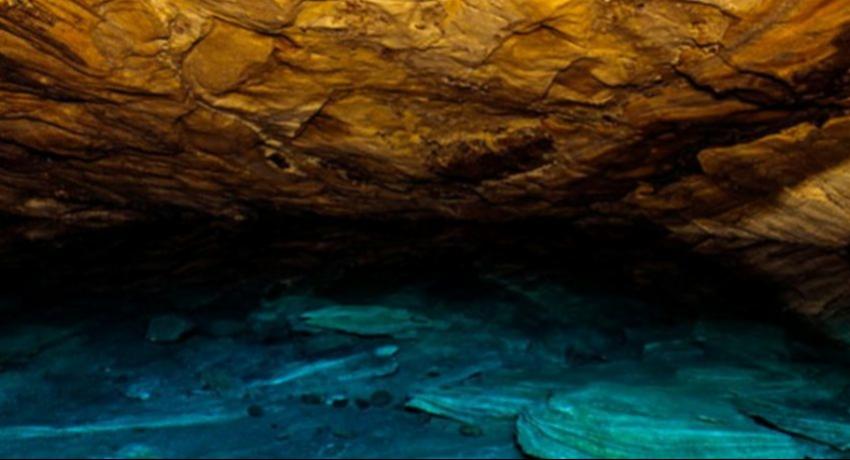
Nildiya Pokuna is a rare natural water source inside an internal cave complex in the Karandagolla Grama Niladhari Division of the Ella Divisional Secretariat, in the Badulla District. It lies within the Ravana Ella Sanctuary and has become popular with both local and foreign visitors, drawn by its unusual geography.
Access has not been straightforward. Hiru News reported in April that the pool remained closed, and the site has previously been shut amid disputes involving guides.
From cabinet decision to signature
The step completes a process reported three weeks ago, when Cabinet approved a proposal by the Minister of Environment to publish regulations bringing tourism at the site under Wildlife Department supervision.
Those regulations were drawn up by a technical committee of university lecturers and representatives of government institutions, which studied the site and submitted a report on managing tourism there. The draft was subsequently reviewed and confirmed by the Legal Draftsman.
What is new in Sunday’s report is the framing — a formal tourism zone declaration rather than regulation alone — along with the minister’s name and a date for the signature.
The stated aim throughout has been to let tourism continue while protecting what officials describe as a sensitive natural resource. It follows a run of measures tightening management of protected areas, including digital ticketing at national parks and a development plan for Yala.
What has not been reported
NewsFirst did not say what the tourism zone designation will mean in practice — whether visitor numbers will be capped, whether ticketing or licensed guiding will be introduced, whether the site will reopen on gazetting, or under which ordinance the declaration is made. Reporting on the August cabinet decision cited the “Wildlife and Flora Ordinance”; the statute governing sanctuaries in Sri Lanka is the Fauna and Flora Protection Ordinance. No other newsroom had covered Sunday’s announcement at the time of writing.
Update, September 7: the gazette is signed, and the rules are published
Minister Patabendi signed the Extraordinary Gazette on Monday as scheduled, Hiru News reported, citing a statement from the ministry’s media unit.
The account answers the statutory question raised above. The site is declared under subsection (2) of section 2 of the Fauna and Flora Protection Ordinance — not the “Wildlife and Flora Ordinance” cited in reporting on the August cabinet decision. Compliance with safety measures and guidelines set by the Director General of Wildlife Conservation is mandatory under the regulations.
Who may enter
- Children under 10 are prohibited from entering the cave entirely
- Those aged 10 to 18 may enter only when accompanied by a guardian
- Students — defined as those in school uniform, carrying a student identity card, or holding formal documentation from the head of their institution — are restricted to authorised routes
What is prohibited inside
Entering the water of the pool is banned, as is polluting it with waste, detergents or chemicals. The regulations impose a total ban on making noise, operating musical instruments or loudspeakers, lighting fires, smoking, and consuming alcohol or illegal drugs. Visitors may not move rocks or alter their positions, or leave marks or inscriptions on rock surfaces.
A different framing from Sunday’s
Hiru describes the gazette as introducing a sustainable management framework governing visitors, and a set of regulations on the services provided to tourists at the site. It does not describe a tourism zone declaration, which was how NewsFirst characterised the step on Sunday. The substance published on Monday is regulation of access and conduct — closer to the August cabinet decision than to Sunday’s framing.
Hiru still does not say whether the site reopens on gazetting, whether visitor numbers are capped, or whether ticketing or licensed guiding is introduced. It gives no enforcement mechanism or penalties, and no date from which the rules take effect. Hiru renders the minister’s name Dhammika Patabendi; this archive uses the more common Dammika Patabendi.
A third account names who was in the room
Daily Mirror’s report on the signing matches Hiru on the substance — the same prohibitions on entering the water, polluting it, noise and amplified sound, fires, smoking, alcohol and drugs, and on moving rocks or inscribing them — and confirms that visitors must comply with the Fauna and Flora Protection Ordinance, orders issued under it, and the Director General of Wildlife Conservation’s safety guidelines.
It adds the officials present when Minister Patabendi signed: Deputy Environment Minister Anton Jayakody, Ministry Secretary K. R. Uduwawala, Additional Secretary for Policy, Legal Reforms and Parliamentary Affairs Bhuwaneka Herath, Director General of Wildlife Conservation Ranjan Marasinghe, and Additional Secretary Manjula Amararathna.
Two points of difference are worth recording. Daily Mirror does not carry the age restrictions Hiru reported — the ban on children under 10, the guardian requirement for 10- to 18-year-olds, or the route restriction on students. Those remain sourced to Hiru alone.
And Daily Mirror’s own dateline is internally inconsistent: the report is published on 7 September but says the minister signed the gazette “today (9).” The parenthetical day does not match either the publication date or the signing date every other account gives, and appears to be an error rather than a new fact.
Daily Mirror describes the purpose as sustainable management and long-term conservation, which is closer to Hiru’s framing than to the “tourism zone” declaration NewsFirst reported on Sunday — leaving that characterisation still resting on NewsFirst alone.