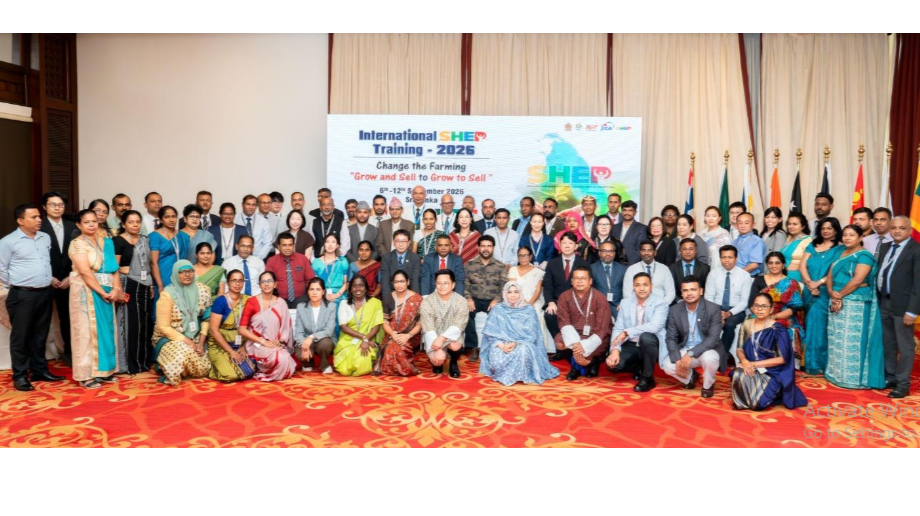
The Japan International Cooperation Agency (JICA) and Sri Lanka’s Department of Agriculture have brought 33 participants from 11 Asian countries to the island to study how Sri Lanka has implemented the Smallholder Horticulture Empowerment and Promotion (SHEP) approach, EconomyNext reported.
They spend five days, from September 7 to 11, observing how the approach has been adapted within Sri Lanka’s agricultural extension system, following a two-week theoretical module held in Japan.
Participants are visiting the Dedicated Economic Centre at Keppetipola, where they conduct market surveys and meet traders, buyers, farmers and agricultural extension officers, before travelling to SHEP farmer groups in the Nuwara Eliya District.
From “grow and sell” to “grow to sell”
Developed originally in Kenya, SHEP aims to shift farmers’ thinking from “grow and sell” to “grow to sell” — deciding what to plant on the basis of market demand rather than habit. JICA says the approach is now used in more than 60 countries.
Shigeo Honzu, Chief Representative of the JICA Sri Lanka Office, highlighted the country’s record in implementing the model.
SHEP was introduced to Sri Lanka through a JICA technical cooperation project that ran from July 2021 to March 2026. With that project now closed, implementation continues through the Department of Agriculture and the Provincial Departments of Agriculture — making this year’s training the first hosted after Sri Lanka took the model fully in-house.
The second regional intake, and a larger one
Sri Lanka has hosted this training before. JICA and the Department of Agriculture ran the first Asia regional programme from September 8 to 12, 2025 at Gannoruwa, Peradeniya, drawing 32 senior officials from 10 countries — Bangladesh, Nepal, the Philippines, Sri Lanka, Thailand, India, Pakistan, Bhutan, the Maldives and Tajikistan — according to JICA’s own account of that event.
This year’s intake is marginally larger, at 33 participants from 11 countries, and has moved its market-survey fieldwork from the Dambulla economic centre to Keppetipola. No outlet has reported the comparison; EconomyNext does not describe the programme as a second edition.
JICA has said the SHEP approach, launched in Kenya in 2006, is intended to reach one million small-scale farmers worldwide by 2030, and that incomes among smallholder vegetable farmers at Sri Lanka’s pilot sites rose by 81 per cent after adoption.