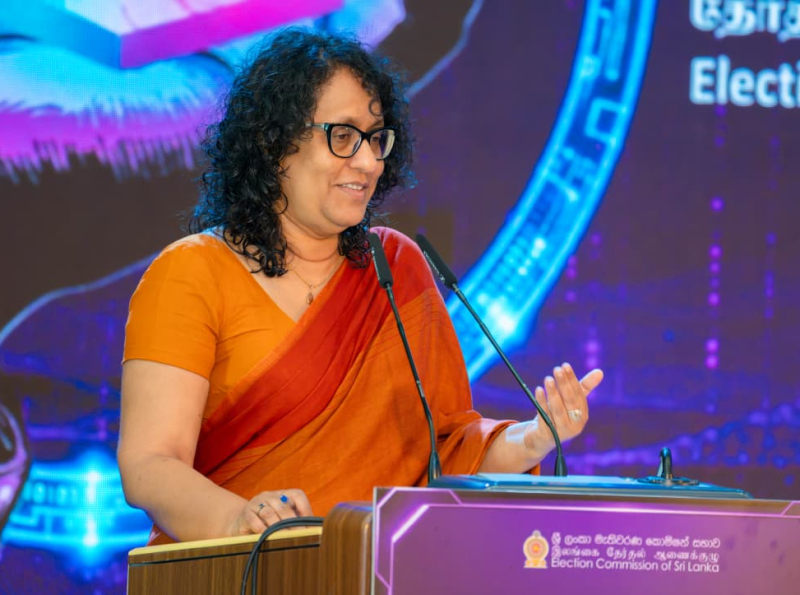
Prime Minister Dr. Harini Amarasuriya said Sri Lanka, with a 95-year legacy of universal suffrage, has embarked on a new path strengthened by technology and grounded in the rule of law, the government news portal reported.
She was speaking at a commemorative event organised by the Election Commission to mark the International Day of Democracy, held on September 15 at the Central Bank’s Centre for Banking Studies in Rajagiriya. A commemorative stamp and first-day cover were unveiled at the event marking the 10th anniversary of the Election Commission’s electronic services.
Two concrete commitments
Beyond the framing, the address carried two operational claims that had not previously been stated in this form.
First, on the diaspora vote: “Measures have also been initiated towards establishing a mechanism that would enable Sri Lankans living overseas to exercise their voting rights,” the Prime Minister said, linking the case to remittance inflows — “Sri Lankans abroad make a significant contribution to the national economy through their remittances, and expanding their democratic participation is an important step towards strengthening our democracy.”
A committee appointed to examine the question handed its final report to the Public Administration Minister in April, recommending a framework covering more than 1.5 million Sri Lankans abroad. The Prime Minister did not say whether the mechanism now under way follows that committee’s recommendations, what form it would take, or whether it would require legislation.
Second, on procurement: she said the digitalisation of state procurement, contract-awarding processes and government purchasing is helping “strengthen transparency and reduce opportunities for fraud and corruption,” with the stated objective of transforming the public service into “a transparent and accountable system that serves the people with dignity.” No timeline, scope or platform was named.
On the courts and the police
The Prime Minister said the rule of law “lies at the heart of democracy,” that everyone must be equal before the law, and that “no individual, regardless of position or status, should stand above it.” She said the government had taken practical steps to restore public confidence in a legal system whose standing “had eroded in recent years.”
The Police, the Criminal Investigation Department and the judicial system have been given “the necessary independence to carry out their responsibilities without political interference,” she said. Implementation of the Anti-Corruption Act has enabled investigations into the misappropriation of public funds, misuse of state property and bribery, “irrespective of political affiliation.”
She framed the 2024 election as the mandate behind this: “The decisive choice made by our people in 2024 is now being reflected in greater transparency, the rule of law, digitalisation, inclusive development and people-centred governance.”
“Democracy is not merely a set of provisions confined to a document,” she said. “It is built on the trust between the people and those entrusted with governing them.”
Reforms across education, health and social welfare are being implemented to strengthen equal opportunities, she added, under a commitment to “leaving no one behind.”
Who attended
The event was attended by Election Commission Chairman R. M. A. L. Rathnayake, Commissioner General of Elections Rasika Peiris, and Leena Rikkilä Tamang, Asia-Pacific Regional Director of the intergovernmental organisation International IDEA, along with ministers, representatives of political parties and senior state officials.
Not reported
The government portal does not say which agency is building the overseas voting mechanism, when it might be operational, or whether it would apply to presidential, parliamentary or local elections. It gives no detail on the procurement digitalisation programme, no figures on Anti-Corruption Act prosecutions, and no remarks from the Election Commission chairman or any other speaker.
Ada Derana carried the address under the headline “Everyone is equal before the law – PM Harini”; its page was unreachable behind a CloudFront block at the time of writing and is not cited here. The Daily Mirror, Hiru News, NewsFirst, the Island, Daily FT and EconomyNext had not filed on the speech.