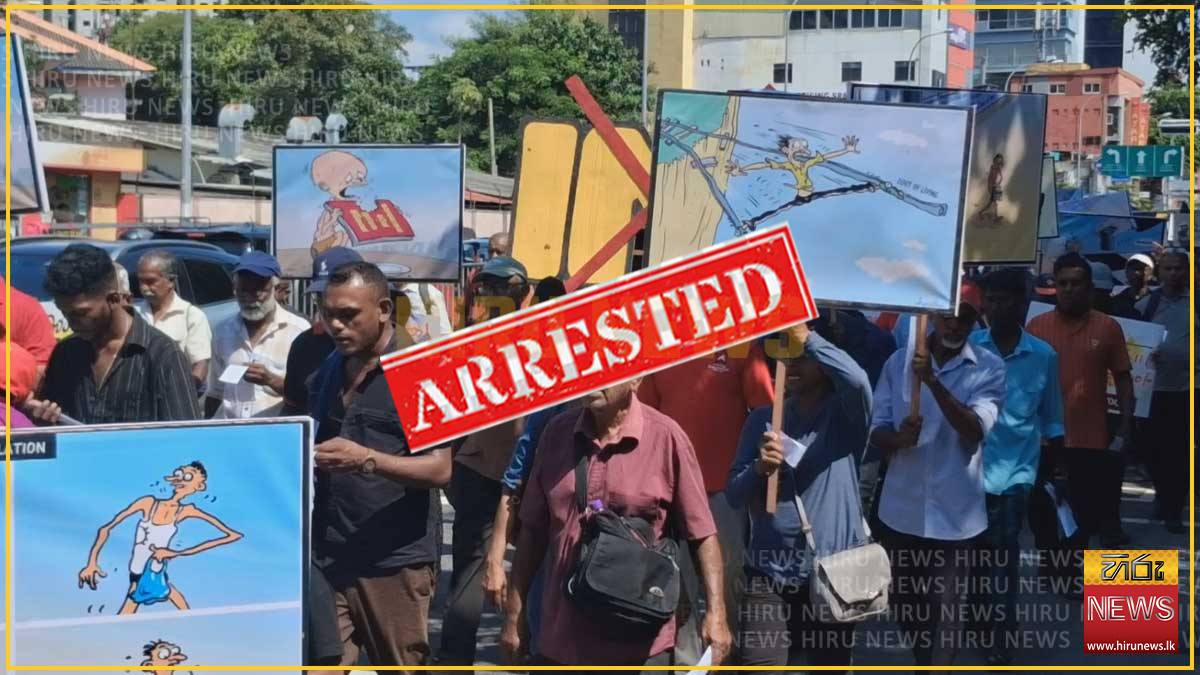
Police arrested six people who took part in a protest march through Colombo on Friday organised by the Frontline Socialist Party and an allied people’s movement, the Police Media Spokesperson said.
The six were arrested on allegations of unlawful assembly and using loudspeakers without prior permission, Hiru News reported. Further legal action is to be taken against them.
The demonstration was called against the government’s tax policies and the rising cost of living, according to Newswire, which reported that the march set out from near Campbell Park in Borella and proceeded through the city toward the Fort Railway Station.
The procession was large enough to close down traffic along its route. Earlier in the day, Hiru reported heavy congestion between Borella and Maradana attributed by police to the march, with motorists advised to take alternative routes. Police said they had taken measures to manage traffic in the affected areas.
What the accounts differ on
The outlets name the FSP’s partner organisation differently — Hiru calls it the “People’s Struggle Alliance”, Newswire gives the Sinhala name Jana Aragala Viyaparaya, which translates as the People’s Struggle Movement. Reports also place the end point of the march variously at the Fort Railway Station and in the Pettah area near the Central Bus Stand. Ada Derana’s account of the arrests could not be retrieved.
Update, 4 October: all six granted bail
All six were produced before the Colombo Chief Magistrate’s Court on Sunday and released on bail, Hiru News reported. They had been produced before the court earlier the same day on the charges police cited at the time of arrest — unlawful assembly and using loudspeakers without prior permission.
The bail order settles the question this article left open about what further legal action would follow the arrests.
The terms of bail, the magistrate, and the next date
Each of the six was released on two personal bails of Rs. 100,000, NewsFirst reported. The order was made by Colombo Additional Magistrate Lahiru Silva, before whom the six were produced on Sunday afternoon, and the case was fixed to be called again on 6 November.
That supplies the three details this article recorded as missing a few hours earlier — the amount of bail, the form it took, and the next court date. Personal bail requires a named surety to stand for the sum rather than cash being deposited, so no money changed hands at the court.
NewsFirst names the bench as the Additional Magistrate’s court, where Hiru’s account said Chief Magistrate’s Court. Both describe the same sitting on the same afternoon; an additional magistrate sits within the Colombo Magistrate’s Court, so this is a difference in how the bench was described rather than two hearings.
Update, 4 October: the movement calls the arrests suppression
The Jana Aragala Movement accused the government of attempting to suppress public protest rather than address the grievances behind it, at a media briefing in Nugegoda on Sunday, Newswire reported.
Movement executive member Duminda Nagamuwa condemned the arrests and named one of the six as Sujith Kuruwita — the first identification of any of the detainees. He said the march had been held under a theme calling for the withdrawal of what the movement described as “unjust taxes”.
Nagamuwa also raised concerns about proposed anti-terrorism legislation, claiming its provisions could be used to classify protests as terrorist activity, ban organisations and detain individuals. He accused the government of continuing the economic policies of the previous administration, including the 18% VAT rate, and claimed tax revenue in the first six months of this year was 25% higher than in the same period last year while taxes owed by large businesses went under-recovered.
The 25% revenue claim and the characterisation of the anti-terrorism bill are the movement’s own, carried here as reported; LankaNewz has not independently verified either.
No account gives a figure for how many people joined the march, and only the movement’s own briefing names any of the six. None reports injuries, any use of force to disperse the crowd, or a response from the FSP itself to the arrests. No source says what the 6 November hearing will be asked to decide, or whether the charges will be pressed to trial.
The charges are the familiar ones
Unlawful assembly and unauthorised use of loudspeakers are the two offences most routinely cited when police break up street demonstrations in Colombo, and arrests on those grounds at FSP-organised protests have recurred over several years. Neither is a charge about the content of the protest; both turn on permits and public-order procedure.
What is reported here is the arrest, not a conviction. No charge has been filed in court on the available accounts, and the allegations have not been tested.