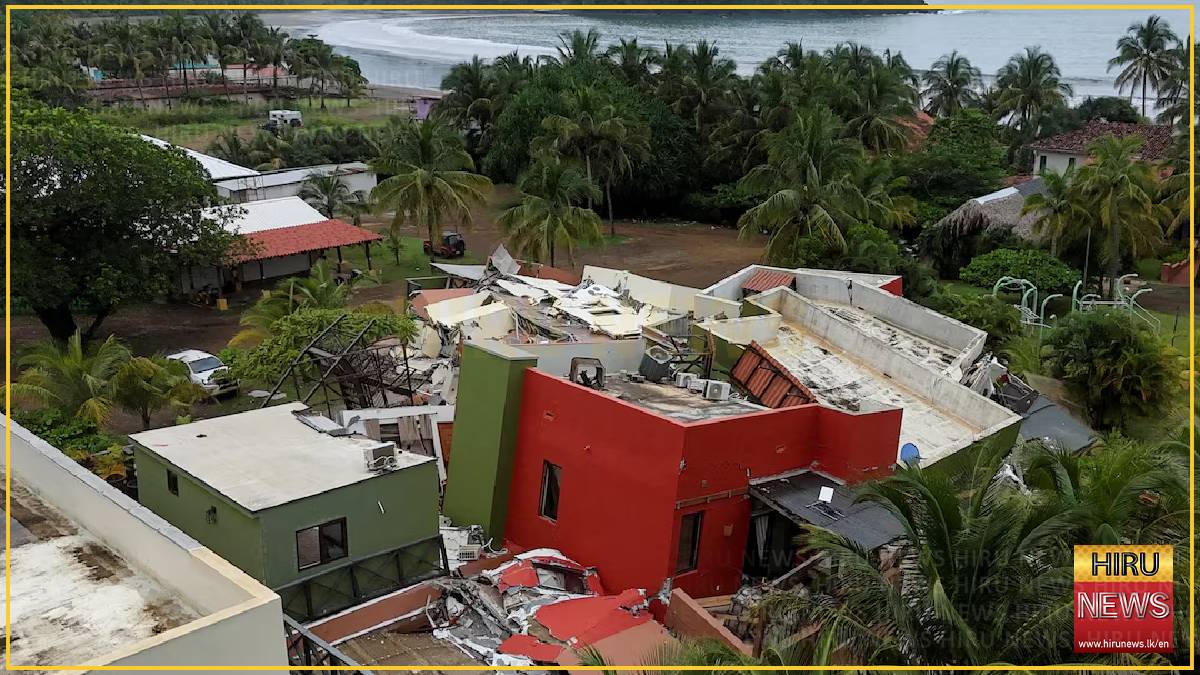
Panama has recorded more than 200 aftershocks since Friday’s magnitude 7.7 earthquake, which damaged close to 900 homes and prompted the government to declare a national state of emergency over the weekend, Hiru News reported, carrying a Reuters account.
No deaths have been reported. At least 27 people were injured, and emergency authorities expect the damage figure to rise as assessments reach remote communities.
The emergency declaration lets the government release up to US$100 million in relief funds without breaching its 2026 fiscal deficit target of 3.5% of GDP, the economy ministry said.
The aftershocks are easing
“We have already recorded more than 200 aftershocks, and they are continuing, but their magnitude is decreasing and the intervals between them are getting longer,” Nestor Luke, director of the University of Panama’s Institute of Geosciences, told Reuters.
That is the clearest indication so far that the sequence is winding down rather than building — a judgement no casualty figure on its own conveys.
The quake
The earthquake struck on Friday with a magnitude of 7.7, centred about 10km southwest of Pitaloza Arriba on the Pacific coast, Al Jazeera reported at the time.
The US National Weather Service issued tsunami warnings for Panama, Colombia, Ecuador, Nicaragua, Guatemala and Chile. In Penonome, a historic building’s tower collapsed and balconies fell from residential blocks.
“We felt it very strongly. It knocked things over in the kitchen, but we’re okay, though we’re very scared,” Rosendo Dominguez, a 60-year-old resident of Herrera province, told the agency.
President Jose Raul Mulino urged calm at the time, saying what had happened “should not be used to cause alarm or disorder.” He has since visited affected areas and called for urgent repairs to roads and bridges to let relief through. At least 14 bridges were damaged in the provinces of Veraguas and Los Santos. Classes were suspended nationwide on Monday.
The United States has pledged $5 million and is sending a 20-member team to assist with rescue work and infrastructure assessment, US Ambassador Kevin Marino Cabrera said.
Why the canal line matters to Sri Lanka
The Panama Canal said shipping operations remained unaffected by the earthquake — a single sentence in the Reuters account that carries disproportionate weight for trade-exposed economies.
The canal has been under sustained strain this year. In April, auction bids for priority transit slots reached US$4 million as the Hormuz blockade pushed traffic onto alternative routes, and in August the authority was still operating under transit caps. With Hormuz still closed — Iran said this week that the US response to its proposal to reopen the strait was “insufficient” — a second simultaneous chokepoint failure would have compounded freight costs on routes Sri Lankan importers and exporters depend on.
Not reported
Neither filing gives the earthquake’s depth or the precise time it struck, nor the number of people displaced or sheltering. Neither says how long the state of emergency will run, or whether the $100 million ceiling is expected to be enough.
The Panama Canal’s statement is reported as a single assertion that operations are unaffected; no filing says whether any transit slots were missed during the quake, whether the locks or the Gatun Lake infrastructure were inspected, or whether the authority has revised its transit caps since. No filing reports any Sri Lankan among the injured.