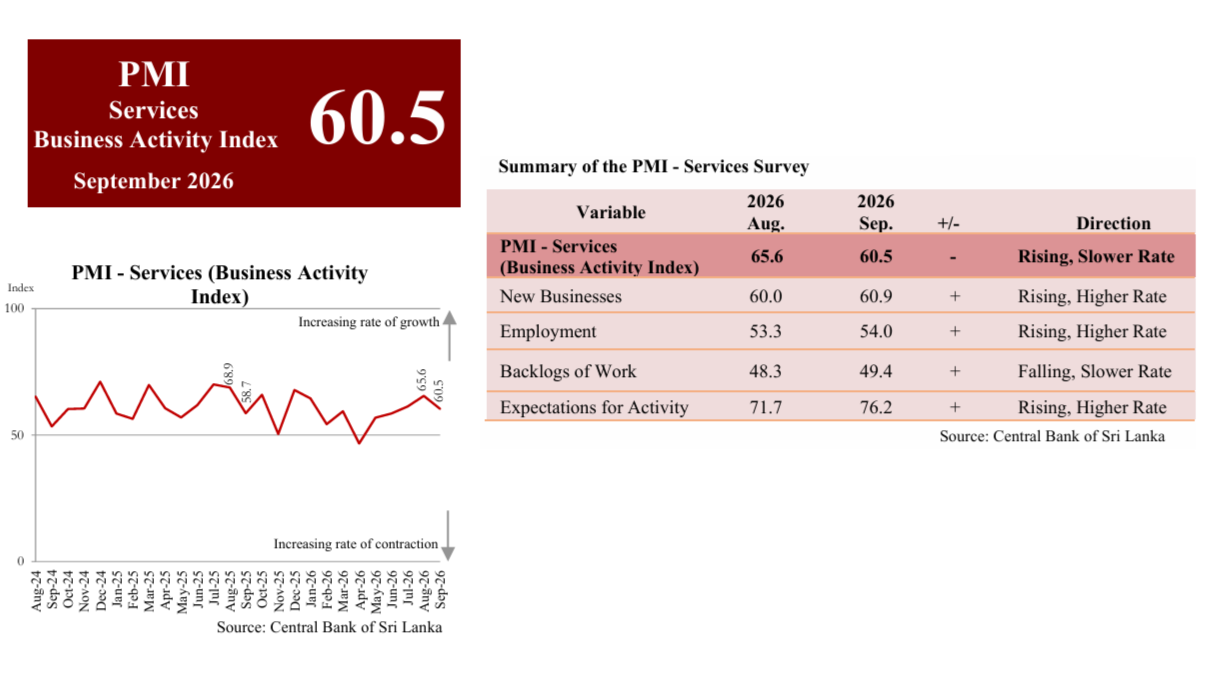
Sri Lanka’s services sector expanded more slowly in September, with the Central Bank’s Purchasing Managers’ Index falling to 60.5 from 65.6 in August, while manufacturing held exactly steady at 53.0. Both readings remain above the neutral 50 threshold that separates expansion from contraction, so both sectors are still growing — services simply grew less quickly than in August.
EconomyNext reported the two halves of the release separately on Thursday evening, citing the Central Bank.
September erases August’s gain, and then some
The services index has now completed a round trip. Read against the monthly sequence this desk recorded when the August release was published, the run is:
| Month | Services | Manufacturing |
|---|---|---|
| June 2026 | 58.5 | 53.0 |
| July 2026 | 61.4 | 55.0 |
| August 2026 | 65.6 | 53.0 |
| September 2026 | 60.5 | 53.0 |
August added 4.2 points to services; September has taken 5.1 away. The index is therefore not merely below August — at 60.5 it sits slightly below July’s 61.4 as well, undoing the whole of the August jump and a little of July’s. No filing on the release makes this comparison.
Manufacturing has been even flatter than the headline suggests. At 53.0 it is unchanged on August, identical to June, and has now printed 53.0 in three of the last four months. July’s 55.0 is the only deviation in the run.
Both headlines move against their own sub-indices
The Central Bank’s survey summaries, published as data cards with the release, show each headline concealing movement in the opposite direction.
On the services side, order intake rose while activity slowed.
| Services sub-index | August | September | Direction |
|---|---|---|---|
| Business Activity (headline) | 65.6 | 60.5 | Rising, slower rate |
| New Businesses | 60.0 | 60.9 | Rising, higher rate |
| Employment | 53.3 | 54.0 | Rising, higher rate |
| Backlogs of Work | 48.3 | 49.4 | Falling, slower rate |
| Expectations for Activity | 71.7 | 76.2 | Rising, higher rate |
This is the mirror image of August. In that month the headline rose 4.2 points while New Business edged down, from 60.2 to 60.0 — expansion driven by work already in hand rather than fresh orders. In September the headline fell 5.1 points while New Businesses rose, to 60.9. Order intake and current activity have now moved in opposite directions two months running, in opposite senses each time.
The strongest figure in the release is one EconomyNext’s report does not carry at all. Expectations for Activity rose to 76.2 from 71.7 — meaning services firms turned more optimistic about the months ahead in the same month their current activity decelerated most sharply this year. The Central Bank attributes the month’s growth to financial services, with education and professional services contributing, and says new business rose on financial services with insurance, education, professional and other personal services adding.
On the manufacturing side, a flat headline hides a demand recovery.
| Manufacturing sub-index | August | September | Direction |
|---|---|---|---|
| Headline PMI | 53.0 | 53.0 | Rising, same rate |
| New Orders | 50.0 | 51.0 | Rising, higher rate |
| Production | 48.4 | 51.0 | Rising from falling |
| Employment | 54.8 | 52.6 | Rising, slower rate |
| Stock of Purchases | 54.8 | 50.0 | Neutral from rising |
| Suppliers’ Delivery Time | 63.0 | 63.0 | Rising, same rate |
Production has crossed back above neutral, from 48.4 to 51.0 — in August it was the only manufacturing sub-index in contraction. New Orders has moved off the neutral line it sat on exactly in August. Pulling the other way, Employment decelerated and Stock of Purchases fell to precisely 50.0, indicating inventories broadly unchanged after an August build-up. The net is an unchanged 53.0.
The sector behind the reversal is the one that caused August’s problem. The Central Bank attributed August’s fall in Production mainly to textiles and wearing apparel, Sri Lanka’s largest export manufacturing sector; it now credits both the New Orders and Production gains to positive developments in textiles and wearing apparel and food and beverages. Suppliers’ Delivery Time is pinned at 63.0 in both months — in PMI convention a high delivery-times reading means orders take longer to fill, so supply-chain friction is unchanged rather than easing.
The Central Bank says the manufacturing outlook “remains positive, driven largely by optimism on year-end seasonal demand,” and repeats, in the same words it used in August, that “broader global economic uncertainties continued to pose downside risks to the outlook.”
Context
The readings land in a week when the IMF’s World Economic Outlook flagged strain on global resilience and the Colombo bourse closed below 20,000 for the first time since August 2025.
Not reported
EconomyNext’s two filings give no figure for services Expectations for Activity, Employment or Backlogs of Work — those levels are taken from the Central Bank’s own survey-summary cards issued with the release. Neither filing says which services sub-sectors decelerated, nor offers any explanation for a 5.1-point fall in the headline index. Neither gives the Central Bank’s quantified expectations for the next quarter.
No other verified newsroom had filed on the September release at the time of writing, so this article rests on a single newsroom. That is the normal pattern for this monthly release rather than an oversight: on the August edition, Daily FT, Daily Mirror’s business desk and Lanka Business Online all filed between two and six days after EconomyNext’s same-day report. Those accounts, when they appear, routinely carry sub-index detail worth adding.