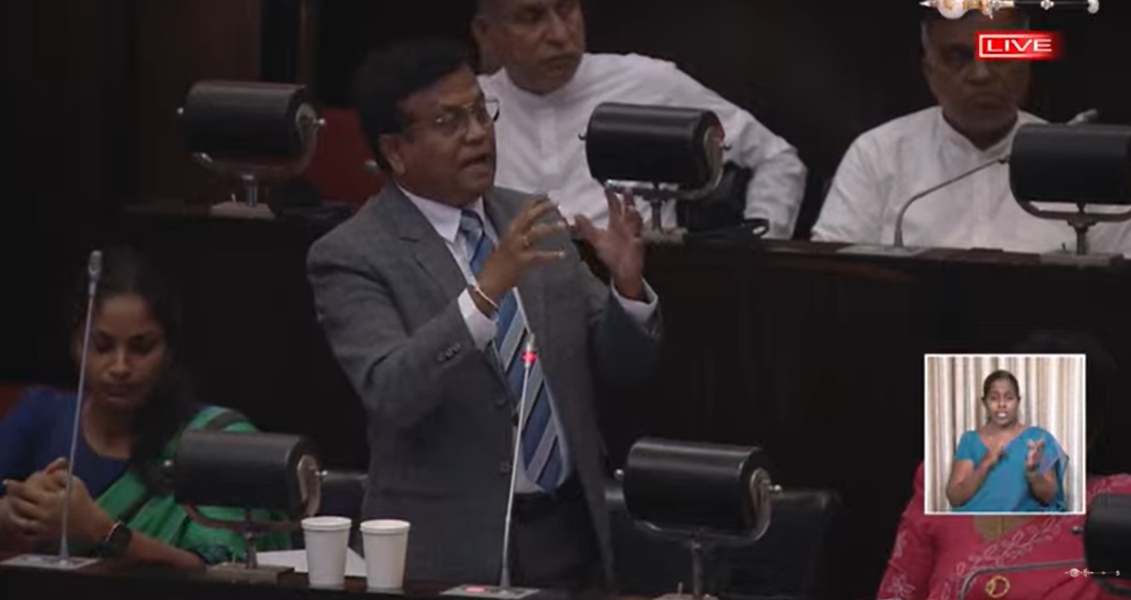
Opposition MP Ajith Perera told Parliament that a formal 31-page communication issued by the United Nations on 30 October states that Sri Lanka’s proposed Prevention of Organised Crimes Bill violates fundamental human rights and international standards.
The disclosure came during a debate covering the Organised Crimes Bill, the Protection of the State from Terrorism Bill and sweeping amendments to the century-old Trusts Ordinance, EconomyNext reported.
The government has defended the package as necessary to dismantle criminal cartels, comply with the Financial Action Task Force and retain EU GSP+ concessions — the trade preference the Ceylon Chamber of Commerce has warned is at risk. Ministers also say the Organised Crimes Bill aligns with the UN Convention against Transnational Organized Crime. The October communication cuts directly against that claim.
What the opposition says the bill does
Perera argued the bill builds an intrusive police apparatus. His specific objections were procedural rather than rhetorical:
- It overrides Sections 24, 25 and 30 of the Evidence Ordinance, the safeguards governing the admissibility of confessions made to police.
- It grants Deputy Inspectors General power to tap citizens’ phone lines without a court warrant.
- It compels journalists to disclose confidential sources.
- It authorises prolonged administrative detention orders.
“Overriding Sections 24, 25, and 30 of the Evidence Ordinance, which have been in force for over a century — what kind of law is that? What kind of justice is that?”
— Ajith Perera, MP
Opposition MP Rauff Hakeem argued the state was building instruments of political control rather than governance safeguards. “Now every civil activity, the government seeks to control through these oppressive and repressive legislations that are being brought,” he said.
Multiple UN special mandate holders and working groups have separately condemned the terrorism bill, which critics say reneges on the commitment to unconditionally repeal the Prevention of Terrorism Act. The Human Rights Commission of Sri Lanka has called for the Organised Crimes Bill to be withdrawn, as has the Bar Association.
Opposition Leader Sajith Premadasa framed it as a breach of the governing mandate. “The mandate was obtained to implement development, not to implement oppression. Not to introduce laws, regulations, and statutes to enforce oppression,” he said. Premadasa also challenged official poverty statistics in the same debate, alleging the Department of Census and Statistics had understated the poverty line by undercounting daily caloric requirements — a charge that lands days before the department’s own survey put poverty back at 16%.
The government’s answer
Deputy Minister of Public Security Sunil Watagala said a shadow network spanning narcotics, extortion and arms trafficking required decisive state intervention, and that the executive would defer to the courts rather than to street protest.
“We listened to the people. A public mandate was given. Based on that mandate, a law was drafted. That law was challenged. That law went before the Supreme Court.”
— Sunil Watagala, Deputy Minister of Public Security
That refers to the petitions challenging the bill’s constitutionality now before the Supreme Court.
Deputy Minister Chathuranga Abeysinghe was blunter, arguing earlier administrations had coexisted with criminal enterprises: “The faction manufacturing distrust and stoking panic over this is the political establishment that cohabited with the underworld.”
What has happened since
The debate took place before two subsequent developments. On the same day the President signalled three amendments to the Organised Crimes Bill, including cutting the proposed detention period from 72 hours to 48. Two days later he went further, saying neither bill would be put to a vote without public consultation and broad consensus.
The Trusts Ordinance amendments bundled into this debate were passed by Parliament the following day.
Not reported
The source does not reproduce the UN communication, name its issuing body or mandate holders, say whether the government has replied to it, or indicate whether it was addressed to the Foreign Ministry or to Parliament. It gives no date for a vote on either bill.
It does not record whether the government disputes Perera’s characterisation of the warrantless-wiretap and journalist-source provisions, or point to the clauses concerned. No response from the Department of Census and Statistics to Premadasa’s caloric-requirement allegation is reported.
Update (8 November): the UN communication’s six concerns, enumerated
Three days after the parliamentary debate, Hiru News reported the communication directly, setting out the points it raises rather than an MP’s account of them. The United Nations warns that the bill would expand police powers and threaten fundamental rights and freedoms, and identifies six principal concerns:
- Access to communications data without a court order — subscriber information, call records and device location data could be obtained from service providers without judicial approval.
- Imprisonment of journalists for court reporting — reporting court proceedings without prior authorisation could be made an offence carrying penalties including imprisonment.
- Gang designation based on association, appearance or language — a person could be classified as a member of an organised crime group using factors such as who they associate with, their clothing, tattoos, hand signs or the language they use.
- Search and confiscation without prior judicial approval — broad powers to search premises and confiscate property on the basis of reasonable suspicion alone.
- Statements to senior police officers admissible as evidence — with concern that such statements may be obtained through influence or threats.
- Detention in a police station for up to a year — suspects could be held for up to 12 months before charges are filed.
Two of these sharpen what Perera told Parliament. His account described warrantless phone tapping; the communication’s concern is framed around metadata — subscriber records, call logs and location data — obtained from service providers. And where he described “prolonged administrative detention”, the communication puts a figure on it: up to 12 months in police custody before charges.
The other four were not in the parliamentary account at all. The gang-designation criteria and the criminalisation of unauthorised court reporting are the most far-reaching of them, and neither has been addressed in the government’s public defence of the bill.
The concern about statements to senior police officers connects to the objection Perera did raise — the overriding of Sections 24, 25 and 30 of the Evidence Ordinance, the safeguards that govern when a confession made to police may be admitted.
Hiru does not name the UN body or mandate holders that issued the communication, give its date, or say whether the government has responded. It does not state whether this is the same 30 October communication Perera cited, though the substance overlaps on the points common to both accounts.


