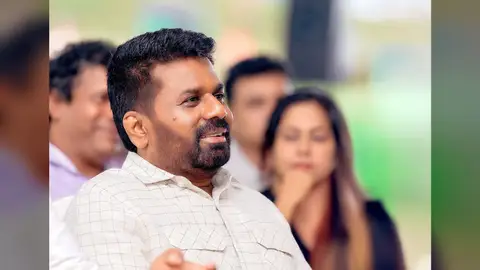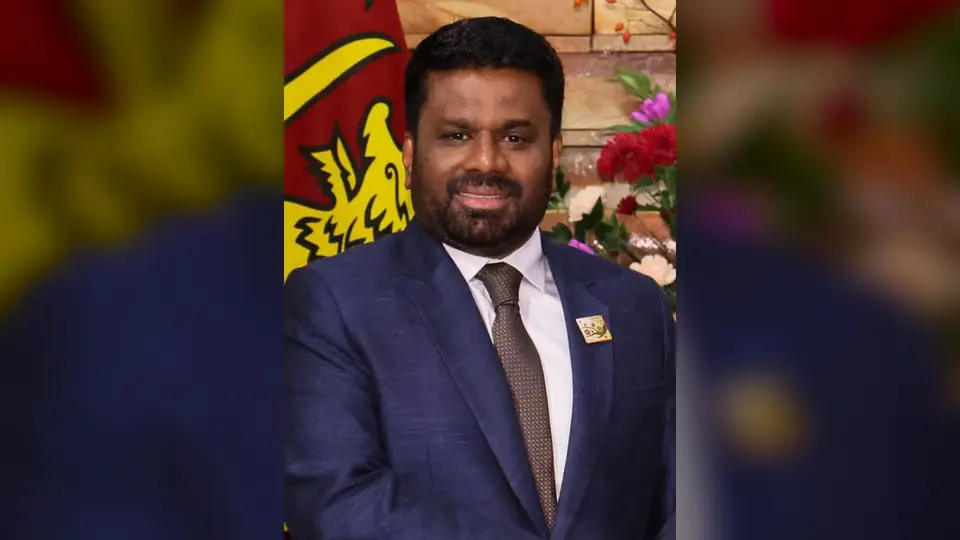
President Anura Kumara Dissanayake says the income level at which the maximum 36 percent Pay As You Earn (PAYE) tax rate applies will be raised to at least Rs 500,000, Hiru News, NewsFirst and EconomyNext reported.
He spoke on Thursday (26 November) to representatives of the National Trade Union Centre, NewsFirst said. Hiru’s short English report names no Budget year, and its Sinhala version speaks of the “forthcoming” Budget. NewsFirst quotes him as saying: “We want to take it to at least Rs. 500,000. Give us another year. That will happen next year.”
Other remarks
NewsFirst reports that he said the government resolves workers’ problems before strikes or protests begin: “We do not give because people shout. We give before the shouting begins.” He said some people even had a problem with that: “We increased the basic salary without giving them an opportunity to protest. That became the issue.” He said he understands doctors’ concerns about lost vehicle permit benefits, but demands that cannot be granted will not be met by shouting.
On PAYE, he said the tax-free threshold rose by Rs 62,500 to Rs 162,500, and that slab increments rose from Rs 41,000 to Rs 50,000. Before the government took office, he said, a person earning Rs 308,000 fell into the 36 percent bracket.
Update: VAT and IMF remarks, EconomyNext’s report and the Budget year
VAT and the IMF. Hiru’s Sinhala report, filed at 9.21 p.m. Colombo time, says the President told the same meeting that the government had talked to the IMF and done things no one else could, including removing VAT on goods such as books and yoghurt. “We did not send any state official to the IMF,” he said, in this desk’s translation, adding that unlike others the government had not sheltered behind the Fund.
Check against the Budget. Hiru reports the VAT removal in the past tense. The Daily Mirror reported on 12 November that Budget 2027 proposes to exempt books and several printed materials from VAT through amendments to the VAT Act, so the books measure was still a proposal then. Hiru does not say when VAT on yoghurt was removed, and yoghurt does not appear in this desk’s earlier Budget 2027 reports.
EconomyNext’s account. EconomyNext (12.33 a.m. on 27 November, Colombo time) quotes him saying the 36 percent threshold will go “beyond 500,000 in the coming year or the year after next”, which is looser than NewsFirst’s “next year”. It has him putting today’s entry point to the 36 percent bracket at 433,000, up from 308,000, and the cost of the planned adjustment at 16,000 million rupees (Rs 16 billion) in revenue, after an estimated Rs 60 billion loss from last year’s relief.
Budget year and monthly figure (28 November). The Daily Mirror and Divaina, reporting the same meeting later, place the Rs 500,000 move in the 2028 Budget. The Mirror calls it a monthly threshold and gives Rs 358,333 a month as today’s entry point to the 36 percent rate and Rs 433,333 under Budget 2027, matching the figures in the Background section below. Divaina carries the 2028 Budget point in a sub-heading. The President’s quoted words in NewsFirst and EconomyNext name no Budget year. His remarks at the same meeting on pay demands and a 2028 pay review are in a separate report.
Background
Budget 2027, presented on 12 November, proposes new PAYE bands from 1 April 2027. This desk’s report says EconomyNext put the start of the 36 percent rate at an annual income of Rs 5.2 million, against Rs 4.3 million now. As a monthly figure, Rs 500,000 would be Rs 6 million a year. Doctors’ unions have warned of action over vehicle permits and other demands.
Not reported: The President’s quoted words in NewsFirst and EconomyNext do not say whether Rs 500,000 is monthly or annual, or which Budget would carry it. The Daily Mirror and Divaina, reporting later, say the 2028 Budget, and the Mirror says monthly. Some NewsFirst figures do not reconcile. It has him saying a person must now earn Rs 1.233 million to reach the 36 percent bracket, against about Rs 358,000 a month now and Rs 433,000 from April 2027 in this desk’s Budget report. EconomyNext’s 433,000 matches the Budget figure. NewsFirst also has him “moving towards making only incomes above Rs. 100,000 taxable” beside a Rs 162,500 threshold that rose by Rs 62,500. NewsFirst does not explain either. The Rs 162,500 and Rs 50,000 figures are the revised Budget 2027 ones, due from 1 April 2027.
Sourcing: five verified newsrooms on the same speech: Hiru News (English and Sinhala pages count as one), NewsFirst (10.33 p.m. Colombo time, 26 November), EconomyNext (12.33 a.m. on 27 November, Colombo time) and, added on 28 November for the Budget-year and monthly-threshold points only, the Daily Mirror (27 November) and Divaina (27 November print edition, read in Sinhala). The first Hiru report’s Sinhala page metadata gives 7.00 p.m. The VAT and IMF remarks rest on Hiru’s Sinhala report alone, and a search for them found no second outlet. Updated with NewsFirst’s account, then with Hiru’s later report and EconomyNext, then with the Mirror and Divaina.
Sources
- Hiru News: 36% maximum PAYE tax rate to apply from Rs. 500,000 incomes under future Budget (President), 26 November 2026
- NewsFirst: “We Solve Problems Before Protests”: President, 26 November 2026
- Hiru News (Sinhala): We talked to the IMF and removed taxes on books and yogurt, President, 26 November 2026
- EconomyNext: Top 36-pct PAYE tax threshold to be raised above 500,000 rupees, President, 27 November 2026 (Colombo time)
- Daily Mirror: Books and printed material to be exempted from VAT under 2027 Budget, 12 November 2026
- Daily Mirror: President warns against salary protests, assures Rs. 150Bn from 2028 budget, 28 November 2026 dateline
- Divaina (Sinhala): We abolished the circular that removed pensions for those joining the public service after 2016, 27 November 2026