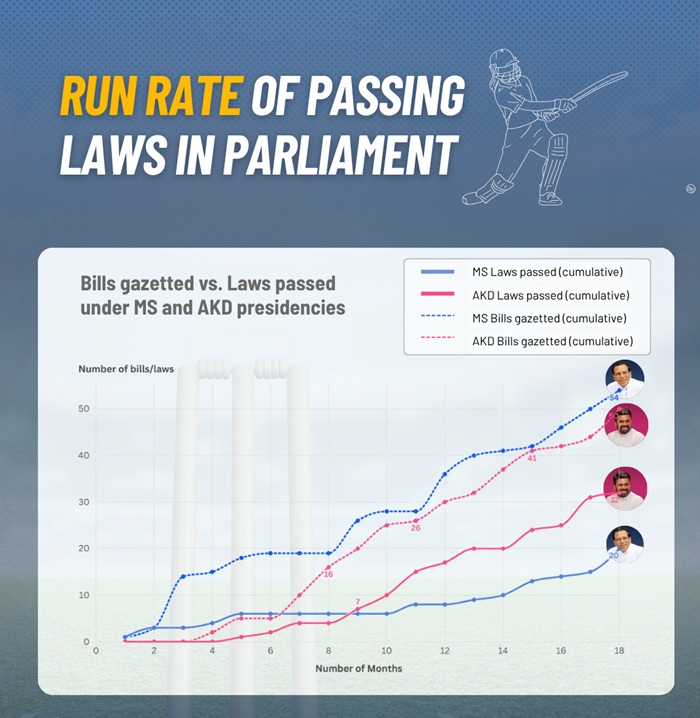
President Anura Kumara Dissanayake’s administration has enacted 32 laws in its first 18 months, more than the 20 passed under former president Maithripala Sirisena at the same point in his term, according to a comparative legislative study by Colombo-based think tank Verité Research.
The research compares the parliamentary record of the two presidencies — both elected on anti-corruption and governance-reform platforms — and concludes that the current administration converts a larger share of its gazetted bills into enacted law.
At the six-month mark, the Sirisena presidency led decisively: it had gazetted 17 bills against Dissanayake’s seven, and passed six laws to AKD’s three. By nine months, the gap on laws passed had closed. By the 18-month milestone, the position had reversed — 32 laws enacted under Dissanayake against 20 under Sirisena.
Sirisena’s government still recorded more gazetted bills overall (54 to AKD’s 50), and tabled marginally more in the chamber (48 to 43), Verité noted. Parliament sat for 126 days during the first 18 months of the Sirisena presidency and 136 days under the Dissanayake presidency, Newswire reported. Both periods included an interim budget and a full-year budget, the study said.
The legislative pace of the current government will draw scrutiny in coming weeks as the cabinet pushes through the Investment Protection Act flagged by the President at last week’s Central Expressway groundbreaking and the Public Security Ordinance State of Emergency extension gazetted on May 28. Earlier Verité work on transparency, including a study released last month on EPF holdings disclosure by the Central Bank, has been cited in parliamentary debate on the same governance themes.
Update — June 7: The United National Party challenged the Verité comparison in a statement on Saturday, arguing that the report measured quantity rather than the impact or significance of the laws enacted. The UNP said the Sirisena administration’s first 18 months produced the 19th Amendment to the Constitution, the Right to Information Act, the National Medicines Regulatory Authority Act and the National Minimum Wage of Workers Act — legislation it said strengthened democratic governance, improved transparency and protected workers’ rights. The party also pointed to former President Ranil Wickremesinghe’s 26-month record of 75 enactments, including the 22nd Amendment, the Economic Transformation Act and the Central Bank of Sri Lanka Act. The Dissanayake administration, the UNP claimed, had failed to introduce similarly impactful legislation despite campaigning on systemic change, with the most notable enactments being the removal of certain entitlements of former presidents and parliamentarians. The party characterised reports that focus on numerical legislative output as portraying a “misleading picture” of the government’s performance, Newswire reported.