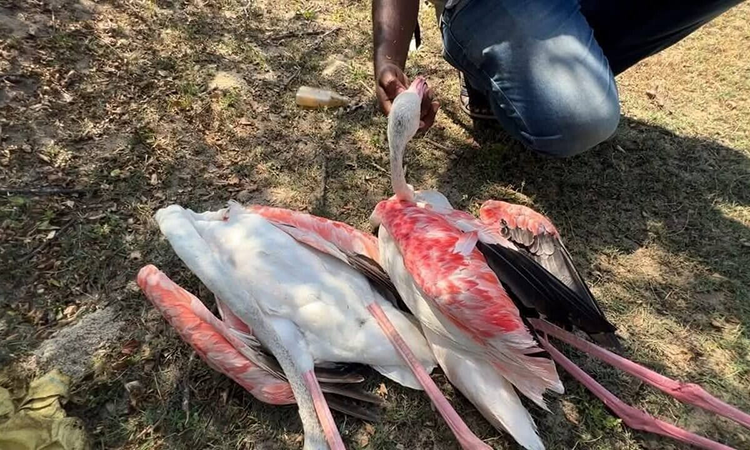
The deaths of three migratory flamingos in Mannar after colliding with overhead power lines have renewed conservationists’ concerns over the impact of energy infrastructure on Sri Lanka’s wetland ecosystems, The Island reported on Monday, citing a Mongabay report published on Saturday.
The birds were initially believed to have been electrocuted, but post-mortem examinations conducted by Department of Wildlife Conservation veterinary surgeon Balachandran Giritharan found that they had suffered fatal injuries after striking the cables while in flight, the report said.
The incident occurred in Mannar, home to some of Sri Lanka’s largest gatherings of flamingos, and has intensified debate over infrastructure development in environmentally sensitive areas, including proposed wind power projects in the same coastal stretch.
Conservationists have long warned that large water birds such as flamingos are particularly vulnerable to collisions with power lines, especially in wetland habitats along migratory routes. Similar incidents have been reported in India, Spain and several African countries.
Experts also pointed to the decline of flamingos at Bundala National Park, once a major habitat for the species in southern Sri Lanka. Ornithologists attribute the decline to changes in the lagoon’s salinity caused by upstream irrigation projects, which eliminated the tiny aquatic organisms that form the birds’ primary food source.
Environmentalists say the latest deaths highlight the need for stronger safeguards including bird-friendly infrastructure planning to protect migratory species and wetland ecosystems. The Mannar Basin lies on the Central Asian Flyway and hosts thousands of migratory waterbirds during the northeast monsoon and post-monsoon seasons.
The findings come as Sri Lanka considers expansion of grid and renewable-generation infrastructure across the northern coast, where wind-resource and solar-resource maps overlap with several Ramsar-listed and DWC-protected wetlands.