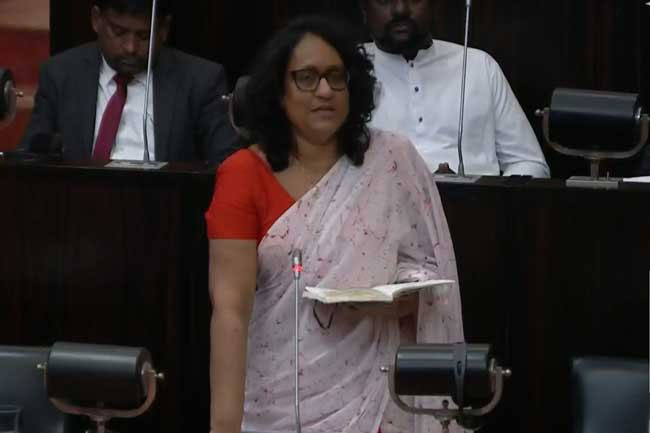
The government has planned major reforms to the higher education sector to align with the new primary and secondary school reforms already under way, Prime Minister and Education Minister Dr. Harini Amarasuriya told Parliament on Wednesday.
A special expert committee has been operating for the past six months and is preparing the recommendations on which the changes will be based, the Prime Minister said in response to a question from MP Manjula Sugath Rathnayaka, according to Ada Derana citing the Prime Minister’s Media Division.
A total of 281,810 students sat the 2025 G.C.E. Advanced Level Examination, of whom 176,538 qualified for university admission. Some 42,937 students are expected to be admitted to universities this year, with the first-degree intake to remain at the same level as in previous years, she said. Qualifying students by stream were: 32,935 in Biological Sciences, 23,012 in Physical Sciences, 39,608 in Commerce, 58,269 in Arts, 4,199 in the General Stream, 12,472 in Engineering Technology and 6,043 in Bio-Systems Technology.
Two new programmes have been added for the 2025/2026 academic year — a Geographic Information Systems course at the University of Ruhuna and an Electronic and Intelligent Systems Engineering course at the University of Peradeniya — each enrolling 50 students. Cut-off marks have been finalised and registration lists are being forwarded to the universities.
The higher education plan sits alongside Grade 6 reforms scheduled for January 2027 and the preschool overhaul targeted for the same year. On preschools, the Prime Minister reiterated that comprehensive reform will be carried out jointly by the Ministry of Education and the Ministry of Women and Child Affairs, with a national regulatory policy and provincial teacher training set for 2026. The first university admissions for the 2025 cohort are scheduled for September.