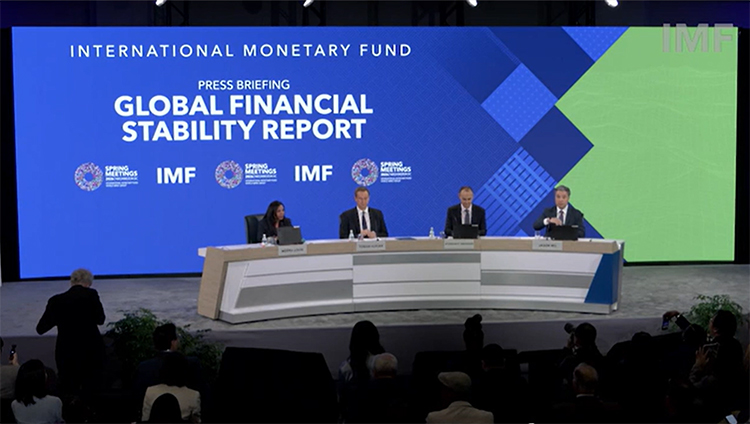
The IMF’s chief economist has warned that the global economy is already drifting toward a more damaging war scenario than its baseline forecast assumes, raising the stakes for energy-importing nations like Sri Lanka.
Pierre-Olivier Gourinchas, presenting the April 2026 World Economic Outlook at the IMF Spring Meetings in Washington, said the reference forecast — built on assumptions of a short-lived conflict and oil averaging $82 per barrel — may already be outdated.
“We are somewhere in between the reference scenario and the adverse scenario. And every day that passes with more energy disruption, we drift closer to the adverse scenario,” Gourinchas said.
The WEO’s three-tier scenario analysis maps the escalating risks. The reference case projects global growth at 3.1%. The adverse scenario, assuming a longer conflict with oil around $100 per barrel, would drag growth to 2.5%. The severe scenario — extended conflict with oil at $110 per barrel — would push growth to just 2.0%, which Gourinchas described as a “close call for a global recession.”
Absent the Middle East conflict, the IMF would have upgraded its global growth forecast by 0.1 percentage points.
Sri Lanka faces acute exposure as an energy-importing developing economy. With oil already above $100 per barrel and the Hormuz strait under contested control, the adverse scenario conditions are already materialising on the ground — threatening fuel supply, electricity tariffs, and the country’s IMF programme targets.