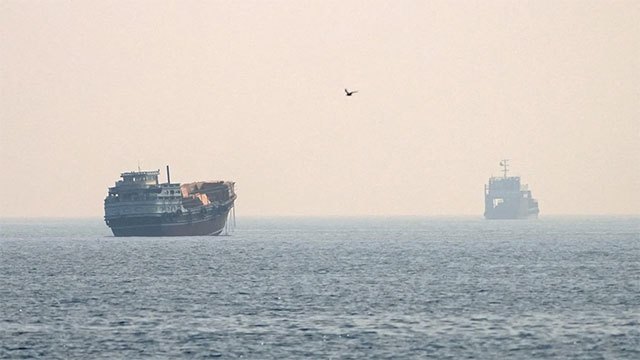
Iran’s Islamic Revolutionary Guard Corps (IRGC) declared the Strait of Hormuz closed early on Sunday (July 12) after firing on a vessel it said was using an unauthorised route, marking a sharp re-escalation of the conflict weeks after a US–Iran ceasefire was struck.
In a statement carried by state media, the IRGC Navy said the strait would remain shut “until further notice and until regional interference by the US ceases,” adding that “no vessel or naval craft will be allowed to pass.” The Guards said the offending ship was hit by a naval cruise missile and stopped after ignoring repeated instructions and diverting from the approved route.
Hours later, US Central Command said it had carried out its “third round of strikes this week” after Iranian forces “blatantly attacked” a Cyprus-flagged vessel, leaving its engine room badly damaged and one civilian crew member missing. Centcom said Iran had been “provided yet another opportunity to demonstrate adherence to the Memorandum of Understanding” — the June ceasefire deal — “but has again failed.” US Defense Secretary Pete Hegseth shared the statement, writing: “Iran made a poor choice. Now they pay.”
The flare-up follows earlier incidents this week in which three commercial tankers were attacked while crossing a US-recommended route through Omani waters. Tehran insists the only “safe” passage is a separate corridor through its own waters. Iranian officials said earlier US strikes killed 17 people and injured 115, prompting Iranian retaliation against US allies in the Gulf.
That retaliation was visible on Sunday, as the United Arab Emirates said its air defences were “engaging” incoming Iranian missiles and drones, with explosions heard across the country. Qatar raised its threat level and urged residents to shelter, while Bahrain activated air-raid sirens.
The renewed closure carries direct risk for Sri Lanka, whose fuel imports transit the strait. A prolonged shutdown in June drove up Ceylon Petroleum Corporation costs and forced QR-based fuel rationing. No statement had been issued by Sri Lankan energy authorities at the time of writing.
Update (July 12): The IRGC later said it had struck and stopped a second “offending vessel” in the strait, warning that continued US and Israeli “aggressions” would draw “even more devastating” responses. In a further escalation, the Guards claimed their aerospace forces had launched ballistic missiles at Jordan’s Prince Hassan air base, saying they destroyed the base’s command-and-control centre and hangars housing MQ-9 Reaper drones in retaliation for US air attacks on Iranian coastal bases — widening the conflict beyond the Gulf states already caught up in the exchange.
Further update (July 12): The confrontation spread further across the Gulf as the IRGC said it had struck US military bases in Kuwait and Qatar as well as Jordan, part of a wave of Iranian attacks on Bahrain, Kuwait, Qatar and the United Arab Emirates launched in response to US strikes that Iran said hit 140 targets on its soil. The UAE said its air defences intercepted incoming missiles and drones, with explosions heard across the country. Qatar reported that three people — including a child — were injured by falling shrapnel after it intercepted an attack, the first civilian casualties reported in this round, and its interior ministry raised the security threat level and urged residents to stay indoors.
Update (July 12): US President Donald Trump said Washington had hit Iran “very hard last night,” telling CNN the United States had struck 140 Iranian military targets in its third round of strikes in a week. He said a deal had been within reach before Iran attacked a merchant ship: “We had a deal with them yesterday. They were giving up everything, and then all of a sudden, two hours after that, they hit a ship with a drone.” Washington also disputed Tehran’s closure claim — while Iran’s authority overseeing the strait’s transit protocol said the passage of vessels was “not possible,” Trump insisted the waterway was “open as far as we’re concerned,” leaving conflicting signals over whether traffic through Hormuz had in fact been halted.
Update (July 13): Oil prices climbed about 3% on Monday as the strikes widened, underscoring the cost risk for Sri Lanka. Brent crude rose 3.08% to $78.35 a barrel and US West Texas Intermediate gained 3.09% to $73.62, according to Reuters. Ship-tracking data from Kpler showed just six vessels transited the Strait of Hormuz on Sunday — the lowest in five weeks — even as Trump insisted the waterway remained open to commercial traffic and Iran maintained it was closed. The International Energy Agency said global oil supply, though up 4.1 million barrels per day in June, was still 9.4 million bpd below pre-war levels. Any sustained rise in crude prices feeds directly into Ceylon Petroleum Corporation import costs.