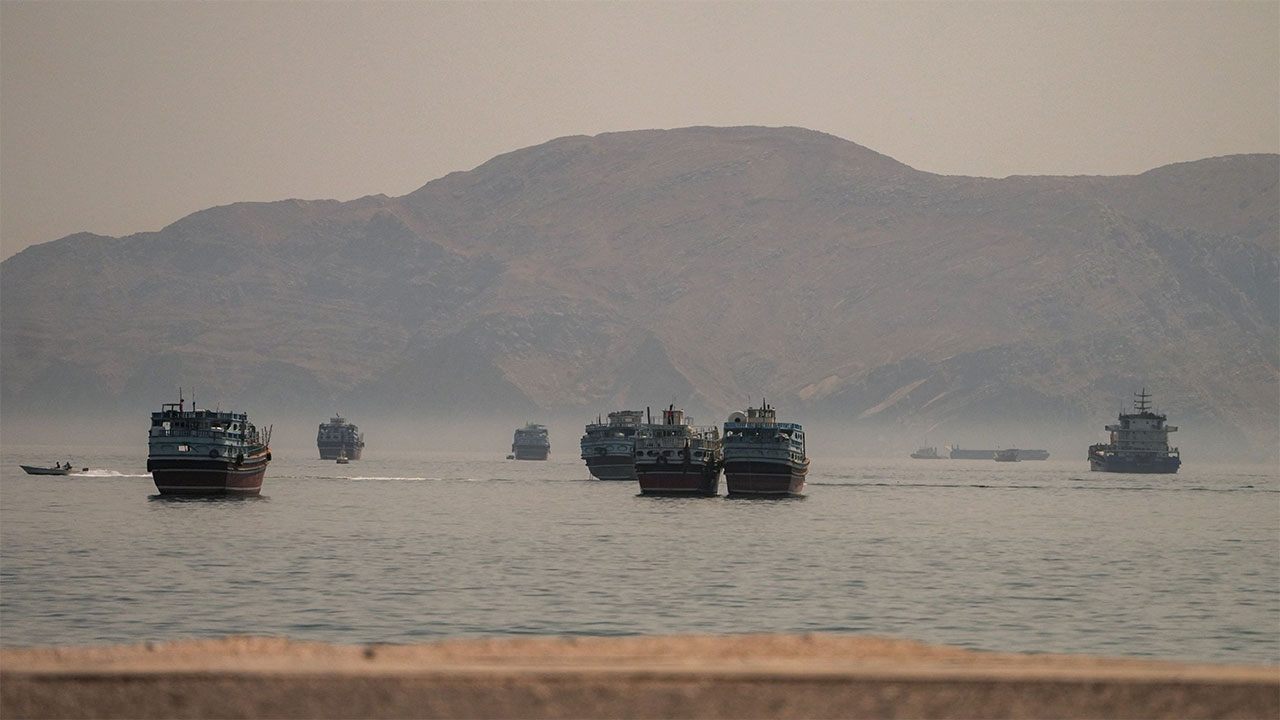
Iran’s top joint military command, the Khatam al-Anbiya Central Headquarters, announced on Saturday evening that the Strait of Hormuz has been closed to all vessel traffic, accusing the United States and Israel of violating the 14-point ceasefire memorandum of understanding signed on June 15.
According to Iran’s state-run Mehr News Agency, the command described the closure as only a “first step” in response to repeated breaches of commitments by both countries and warned that further measures would follow if “aggression” continued. Iranian officials pointed to ongoing Israeli military operations in southern Lebanon — where foreign media reported at least 32 people killed in attacks since dawn — as evidence the agreement was not being respected.
The announcement came as US Vice President JD Vance told Fox News he was confident the ceasefire would hold and said he saw no evidence the strait was closed, setting up an immediate Washington–Tehran dispute over whether maritime traffic through one of the world’s most critical oil chokepoints had actually been suspended. The Khatam al-Anbiya command did not specify how the closure would be enforced or whether warships, mines or escort restrictions had been deployed.
For Sri Lanka, a renewed closure would reverse the relief that drove Brent crude below US$80 a barrel after the deal was signed. The reopening of Hormuz had been central to government projections that fuel subsidies could be passed through to retail prices by August or September. A sustained shutdown would push the Ceylon Petroleum Corporation’s import bill higher, add pressure on the rupee and complicate the US$24 billion sanctions-and-frozen-assets package that underpinned the wider US–Iran agreement.
About one fifth of global seaborne oil and a large share of liquefied natural gas pass through the Strait of Hormuz. The 14-point MoU had explicitly guaranteed unimpeded transit. Tehran has now framed that guarantee as conditional on US and Israeli compliance with the wider deal, including a halt to operations in Lebanon.
Update — June 21: Negotiators head to Switzerland; US disputes Hormuz closure
A high-level Iranian delegation led by chief negotiator Mohammad Bagher Qalibaf — and including Foreign Minister Abbas Araqchi, senior security officials, central bank representatives and oil officials — departed for Switzerland on Saturday for the first major round of post-MoU talks with the United States. US Vice President JD Vance left Washington for the same meetings, with Pakistan announcing that the sessions would begin on Sunday.
White House officials publicly disputed Iran’s Hormuz-closure announcement on Sunday, saying commercial vessels had continued operating in the waterway and that the strait remained open. The US position contradicts Khatam al-Anbiya’s Saturday statement and sets the closure dispute as one of the headline items the Switzerland round will need to resolve, alongside continued Israeli strikes in Lebanon. Both sides have publicly said they want to advance the interim deal signed by President Donald Trump and President Masoud Pezeshkian last Wednesday despite the friction of the last 72 hours.
The IRGC’s “first step” framing — and the US public denial that the closure is actually in effect — leaves the Hormuz transit guarantee in a fragile interim status pending the Switzerland outcome. For Sri Lanka, the dispute keeps the question of whether August-September fuel-price relief can credibly materialise open until the Switzerland talks conclude.
Update — June 21 afternoon: Talks open at Buergenstock; CENTCOM says 55 ships transited Hormuz
Peace talks formally opened at the Buergenstock mountaintop resort in Switzerland on Sunday morning. The US delegation is led by Vice President JD Vance, with envoys Steve Witkoff and Jared Kushner. The Iranian delegation is led by chief negotiator Mohammad Bagher Qalibaf, with Foreign Minister Abbas Araqchi joined by senior security, central bank and oil officials. Pakistan’s Prime Minister Shehbaz Sharif and army chief Field Marshal Asim Munir arrived at the resort to join the talks as mediators. The Buergenstock complex is owned by Qatar, which has also played a mediation role.
US Central Command said 55 merchant ships transited the Strait of Hormuz on Saturday, carrying more than 17 million barrels of oil bound for global markets, and pledged US forces would ensure commercial traffic continued — a direct rebuttal of the IRGC’s closure announcement. President Donald Trump separately said there would be no toll for passage through the strait during the 60-day ceasefire window or after, while warning on social media that the US could levy a toll “for services rendered as the Guardian Angel” of the Middle East if peace talks failed.
Mohammad Mokhber, an adviser to Iranian Supreme Leader Ayatollah Mojtaba Khamenei, accused Washington of failing to implement the first of the 14 points of the deal — which include a ceasefire “on all fronts” including Lebanon — and warned that Middle East energy flows would stay halted as long as the agreement was “only on paper.” Iranian Oil Minister Mohsen Paknejad signalled the other side of the same bargain, saying hundreds of investment opportunities would be opened to Western stakeholders if the pact were honoured.
Israeli broadcaster Channel 12 reported that Prime Minister Benjamin Netanyahu and the defence minister had ordered the military to hold fire in Lebanon while declining to withdraw from captured areas. A Hebrew University poll provided to Reuters found that about 92 per cent of Israelis believed Iran benefited more than Israel from the joint Israeli–US military campaign.
Update — June 22: 60-day roadmap agreed; talks survive Trump threats and Day 1 walkout
Pakistan and Qatar issued a joint statement on Monday announcing that Iran and the United States had agreed on a roadmap towards a final deal within 60 days. “The High Level Committee has agreed upon a roadmap towards reaching a final deal within 60 days, laying the foundation for the immediate commencement of further technical talks,” the mediators said. The statement also confirmed the creation of a “de-confliction cell” with Lebanon, facilitated by the mediators, to ensure adherence to the termination of military operations there.
The roadmap announcement came after a tense opening day. Fox News reported that just before talks formally began, President Donald Trump warned Iranian officials “you won’t have a country” if they closed the strait again, and renewed his threat that the United States could take over the waterway and charge tolls. Iran’s semi-official Tasnim news agency, citing an informed source, said the Iranian delegation initially refused to return to the negotiating room after Trump’s threats became public, with messages still passing through the Pakistani and Qatari mediators. A US diplomat involved in the talks told Reuters the Iranians “never left and are still here meeting and negotiating deep into the night,” covering “the Strait, Lebanon, nuclear issues, and details of implementing the MOU.”
Shipping data from analytics firm Kpler showed five vessels passed through the strait on Sunday, a sharp drop from the 26 ships spotted a day earlier, although the figures may exclude vessels with transponders switched off. Iran’s Fars news agency cited a military source as saying no new permits were being issued for ships to cross until further notice. Brent crude futures rose more than US$1 to US$81.66 a barrel in early Monday trading, partly reversing the post-MoU drop that had carried into last week. For Sri Lanka, the 60-day roadmap window now becomes the new horizon for whether the August–September fuel-price relief projected by Energy Minister Bimal Rathnayake can credibly materialise, with the Hormuz transit question still hostage to whether the Lebanon de-confliction cell holds.
Update — June 23: US issues 60-day oil sanctions waiver; Iran disputes IAEA inspector claim
The US Treasury on Monday issued a 60-day “general license” temporarily lifting sanctions on the production, sale and delivery of Iranian oil — including direct imports of Iranian crude into the United States — for the first time in decades. The waiver runs until 21 August and unlocks banking, insurance and transport services that Tehran had previously routed through opaque secondary networks. Treasury Secretary Scott Bessent said on X that in exchange Iran had committed to “free and open transit” through the Strait of Hormuz and to permitting International Atomic Energy Agency inspectors back into the country.
Vice President JD Vance, speaking in Switzerland on Monday morning, said discussions with the IAEA “could be happening as soon as today” and that the inspection process would resume “at a minimum this week.” President Donald Trump posted that Iran “will agree to have Major Weapons Inspections.” But Iran’s foreign ministry spokesman Esmail Baqai told state news agency Irna later on Monday that Tehran had made “no new commitments” on inspectors and that any engagement with UN monitors would proceed “under existing procedures set by Parliament and the Supreme National Security Council.” Iran suspended IAEA access to bombed nuclear sites during the 12-day war last summer and the UN watchdog pulled out its remaining personnel the following month.
For Sri Lanka, the Treasury waiver materially changes the economics of the August–September fuel-price-relief horizon: a flood of newly legal Iranian crude into world markets would weigh on Brent and ease the Ceylon Petroleum Corporation’s import bill if implementation holds. But the public US–Iran dispute over whether nuclear inspectors are actually returning keeps the 60-day window politically fragile, and the gap between Bessent’s quid-pro-quo claim and Baqai’s denial sets up the first concrete test of whether the Buergenstock roadmap can survive implementation.