Israel and Lebanon have agreed to implement a ceasefire, the US State Department announced, contingent on a “complete cessation” of attacks by the Iran-backed Hezbollah and the evacuation of all the group’s operatives from an Israeli-controlled zone in southern Lebanon stretching from the Litani river to the border.
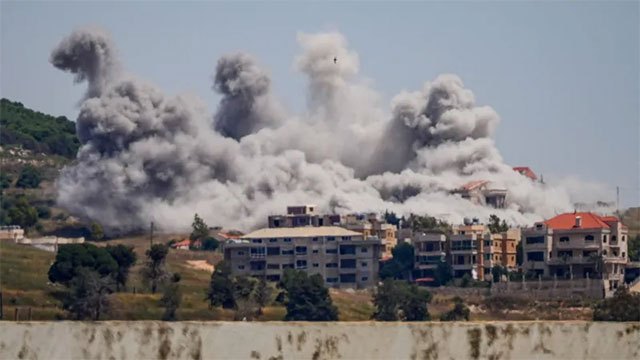
The announcement, reported by Ada Derana, comes after Israeli strikes killed at least nine people in southern Lebanon on Wednesday and Hezbollah fired rockets into northern Israel, testing a shaky truce first agreed in April. The Lebanese health ministry said two paramedics were among the dead after an ambulance was struck in the Chehour area; the Lebanese army said one of its soldiers was killed in a drone strike between Nabatieh and Kfar Tebnit.
The State Department said the United States would help set up “pilot zones in which the Lebanese Armed Forces will take exclusive control of the territory to the exclusion of all non-state actors”. All parties also “reaffirmed that the future of the relationship between Israel and Lebanon must be decided by the two sovereign governments”, the statement said, rejecting any attempt by state or non-state actors to “hold Lebanon’s future hostage”.
Israel and Lebanon are scheduled to meet again on 22 June for further talks “with a view toward reaching a comprehensive agreement”. US Secretary of State Marco Rubio told reporters before the announcement that he hoped the parties would produce “an action plan on a track for security in [Lebanon], independent from Hezbollah”. Hezbollah has not commented publicly on the latest deal, and a member of the group’s political council told the BBC earlier this week that the group did not recognise the findings of the Washington-mediated talks.
The new commitment builds on a partial ceasefire announced on Monday under which Israel had agreed not to bomb Beirut in exchange for Hezbollah pausing attacks on Israel. That arrangement followed weeks of cross-border exchanges that had repeatedly tested an earlier 10-day truce broken by Israeli strikes on southern Lebanon. President Donald Trump said on Wednesday he wanted to separate the US-Iran talks from the Lebanon track, a position pushed back by Iranian Foreign Minister Abbas Araghchi, who warned that Tehran’s armed forces were “fully prepared” to resume the war if Israeli aggression against Beirut continued.