The Israeli Air Force has struck military targets in western and central Iran, the Israel Defense Forces (IDF) said early Monday, hours after Tehran fired waves of ballistic missiles at Israel over the Lebanon conflict.
“A short while ago, the Israeli Air Force struck military targets belonging to the Iranian terror regime in western and central Iran,” the IDF said in a statement on Telegram. The military gave no casualty count and did not identify the precise locations hit.
Iranian state media confirmed explosions across multiple cities. State-run Mehr News reported several loud blasts in the capital Tehran. State-run IRIB reported additional explosions in Tabriz and Isfahan.
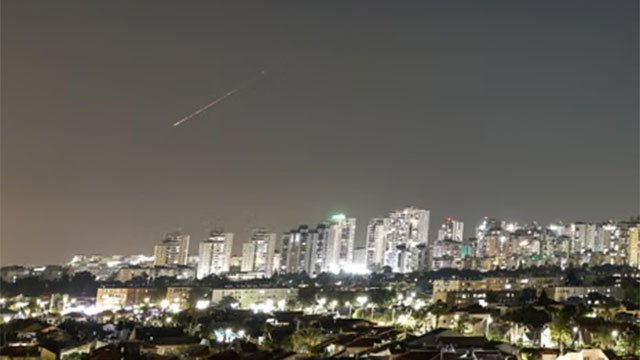
The Israeli action followed a Sunday salvo by the Islamic Revolutionary Guard Corps that targeted Israel’s Ramat David Airbase near Nazareth — the first direct Iranian missile attack on Israel since a ceasefire was agreed in early April. Iran’s military framed its strike as retaliation for Israel’s renewed bombing of Beirut’s southern Dahiyeh district earlier the same day.
The strikes came despite a direct intervention by US President Donald Trump, who pressed Israeli Prime Minister Benjamin Netanyahu in a phone call on Sunday to hold off on a counter-attack and protect ongoing US-Iran peace negotiations. Trump told the Financial Times that fresh strikes “would not have any impact on the deal” and that he, not Netanyahu, would decide its terms.
A senior advisor to Iran’s Supreme Leader, quoted by state media on Sunday, warned that Tehran would move to block the Bab al-Mandab maritime corridor — a separate Red Sea chokepoint to the Strait of Hormuz already partially closed by Iran — if Israel escalated further. Both straits sit on the supply route for Sri Lanka’s crude and refined fuel imports, and any disruption to Bab al-Mandab would compound the existing Hormuz risk premium that has been driving Brent crude back above $95 a barrel.
Shortly after midnight on Monday, the IDF Chief of Staff, Lt. Gen. Eyal Zamir, said his forces had not yet been directed to attack Iran but would do so “with determination” once given the order. The Telegram statement on Monday morning indicates that order has now been issued.
The wider war has been stalemated since US and Israeli strikes on Iran paused in early April. Tehran has since blocked most shipping through the Strait of Hormuz, and Washington has imposed a counter-blockade on Iranian ports.
Update — June 8 (military briefing): Speaking to reporters on Monday for the first time since hostilities resumed, an Israeli military official said the IDF was preparing for “at least several days of fighting” with Iran and the possibility of a prolonged campaign, Ada Derana reported, citing CNN. The official accused Iran of breaking the April ceasefire when it began firing ballistic missiles late on Sunday night and put the count at close to 30 Iranian missiles since the first attack, with Houthi forces in Yemen firing two more — one intercepted and one falling short of Israeli territory. The official said Monday’s strikes were carried out in two waves: the first targeting strategic aerial defence systems and the second targeting a petrochemical facility the IDF said assists in the manufacture of ballistic missiles and other weapons. All strikes were carried out solely by Israel, the official said, with US support limited to intercepting some incoming missiles in Israel’s aerial defence. IDF Chief of Staff Lt. Gen. Eyal Zamir spoke twice with CENTCOM commander Adm. Brad Cooper in the past 24 hours.
Sources: Ada Derana — Israel says it struck targets in Iran after Tehran fires waves of missiles (Reuters wire), Ada Derana — Israel preparing for several days of fighting with Iran (CNN wire).