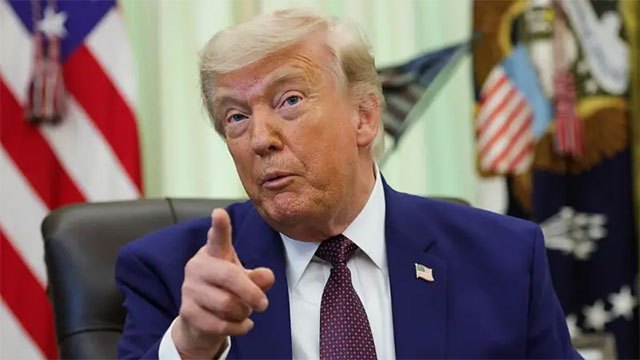
US President Donald Trump said on Sunday he would tell Israeli Prime Minister Benjamin Netanyahu not to strike back after Iran fired a salvo of missiles at Israeli targets in retaliation for an Israeli attack on the outskirts of Beirut, news outlet Axios reported.
Trump and Netanyahu spoke by phone for a little under half an hour, an Israeli official told reporters. The White House and Netanyahu’s office did not immediately respond to requests for comment.
“Israel had its strike and Iran had its strike. We don’t need another one,” Trump told Axios. “We are very close to a final deal with Iran. It is going to be a good deal. I don’t want it to blow up because of what is happening now.”
The diplomatic intervention follows a day in which Iran’s Revolutionary Guards fired missiles at Israel’s Ramat David Airbase, with Tehran linking the strike to Israel’s renewed Lebanon operations. An Israeli source told Reuters on condition of anonymity that Israel would retaliate, but the military’s Chief of Staff, Lt. Gen. Eyal Zamir, said shortly after midnight that his forces had not been ordered to attack Iran “so far” and would do so “with determination” once given the order.
Iran has consistently said any peace deal with Washington must include a parallel ceasefire in Lebanon, which Israel invaded in March in pursuit of Hezbollah fighters who had fired rockets and drones across the border in solidarity with Tehran. Iran’s chief peace negotiator, parliamentary speaker Mohammed Baqer Qalibaf, said US bases and Israeli assets remained “legitimate targets” because of hostile acts, including the “violation of agreements over Lebanon.”
In a prerecorded NBC News “Meet the Press” interview that aired Sunday to mark 100 days of the conflict, Trump warned: “We’re very close to a deal, or I’m going to blow the hell out of them.”
The Israeli strikes Sunday in Beirut’s southern Dahiyeh district — a long-standing Hezbollah stronghold — were ordered, Netanyahu said, in response to Hezbollah firing toward Israel. Trump had rebuked Netanyahu with obscenities in a phone call last week, after which the Israeli leader appeared to abandon plans to strike Beirut — until Sunday’s strike broke that holding pattern.
The wider war has been stalemated since the US and Israel paused their attacks on Iran in early April, with Tehran blocking most shipping through the Strait of Hormuz, the main transit route for Middle East oil, and Washington imposing its own blockade of Iranian ports. The exchange follows the June 7 decision to redirect frozen Iranian assets to Gulf reconstruction and underscores how fragile the path to a final settlement has become.
Update — June 8 (FT interview): In a parallel interview published by the Financial Times on Sunday, Trump made the same case to a wider audience in starker terms, saying the Sunday exchanges would not affect his administration’s peace track with Tehran. “It’s not going to have any impact on the deal,” he told the FT. “I call the shots. I call all the shots. He doesn’t call the shots.” The remark, his sharpest public assertion of authority over Netanyahu in the current cycle, came as Iran’s Deputy Foreign Minister Kazem Gharibabadi separately rejected reports that Washington would redirect Iranian assets to Gulf neighbours, calling any such diversion illegal and saying Tehran would respond. Five hours after the IRGC missile salvo, Netanyahu had not publicly commented; hours later, the IDF struck military targets in western and central Iran. Brent crude futures opened more than 2% higher above $95 a barrel on Monday on the renewed exchange.
Sources: Ada Derana — Trump says he will press Israel to hold back after Iran retaliates for Beirut attack and Ada Derana — Trump says new Israel, Iran strikes won’t affect peace deal.