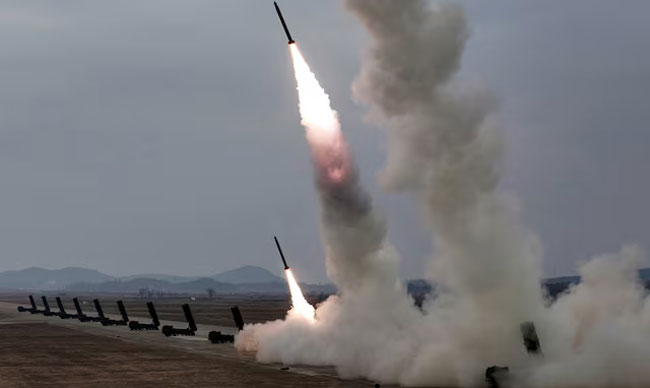
North Korea fired ballistic missiles from its east-coast port of Sinpo into the sea on Sunday, extending an accelerating run of launches that experts say are being shaped by the seven-week U.S.-Israeli war against Iran.
South Korea’s military said the missiles flew about 140 km before splashing down. Japan confirmed the projectiles did not enter its exclusive economic zone. Sunday’s test was Pyongyang’s fourth launch this month and the seventh of 2026.
South Korean former presidential security adviser Kim Ki-jung said the launches appear intended to display independent deterrence. “The missile launches may be a way of showing that — unlike Iran — we have self-defence capabilities,” he said, adding that the North “also appears to be exerting pressure preemptively and make a show of force before engaging in dialogue with the United States and South Korea.” The Blue House convened an emergency security meeting and called on Pyongyang to halt the provocations.
The U.S.-Israeli campaign against Iran, which includes curbing Tehran’s nuclear programme as a stated objective, could reinforce Pyongyang’s own nuclear calculations, South Korean officials and analysts say. In late March, leader Kim Jong Un declared North Korea’s nuclear-armed status irreversible.
U.S. President Donald Trump — preparing for a summit in China next month — and South Korean President Lee Jae Myung have both publicly expressed interest in holding talks with Kim, though no meetings have been announced. Separately, IAEA Director General Rafael Grossi has warned that North Korea has likely added a new uranium enrichment facility and made “very serious” advances in weapons production.
The launches add a fresh nuclear-proliferation dimension to a Middle East crisis that has already pushed Hormuz transit and global oil prices to the centre of international concern.