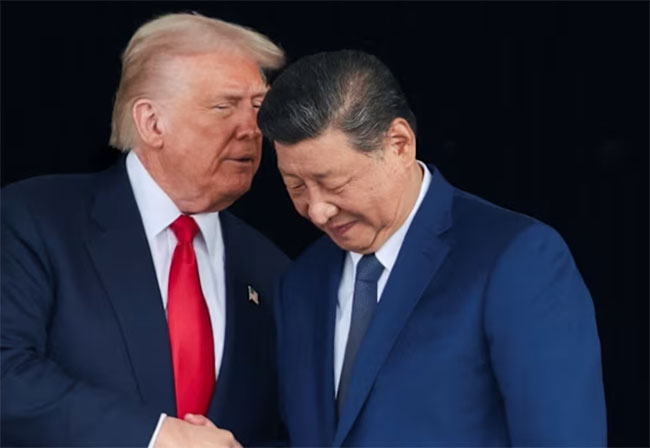
Beijing has confirmed that US President Donald Trump will travel to China this week to meet Xi Jinping, in the first visit to China by a US president in nearly a decade and a key test of the fragile trade truce between Washington and Beijing.
The visit will run from 13 to 15 May. Executives from some of America’s biggest companies — including Boeing, Citigroup and Qualcomm — are expected to travel with Trump, potentially to announce deals with Chinese firms, the BBC report carried by Ada Derana said.
In April 2025, Trump unveiled sweeping import taxes on countries worldwide. A major effect was a tit-for-tat trade war with China that saw both sides impose tariffs topping 100 percent. The tariffs were paused after a Trump-Xi face-to-face meeting in South Korea in October, but threats from both sides have continued and the visit will test whether the suspension can be converted into a durable settlement.
Trump returned to office in 2025 and doubled down on tariff policy, imposing 20 percent duties on China for alleged fentanyl flows and adding a 34 percent “Liberation Day” levy on Chinese goods. Beijing retaliated with duties on US agricultural goods, hitting Trump’s farm-state voter base, before leveraging its near-monopoly on rare earths to force the October bargain. As part of that deal, Beijing suspended export controls and resumed buying US agricultural goods; Washington dropped part of its fentanyl-linked tariffs and paused planned reciprocal-tariff increases. Restrictions on the sale of advanced semiconductors were partially lifted, though not for the most cutting-edge chips.
A permanent resolution remains elusive. China’s heavy investment in manufacturing means its businesses must sell abroad as domestic spending remains weak, while the US continues to press for greater market access and structural changes.
The Beijing trip also intersects with Sri Lanka’s energy-security calculus. China has been pressing Iran to ease the Strait of Hormuz closure that has driven the Brent crude rally to $104, and Trump’s earlier 50-percent secondary tariff threat against Iran weapon suppliers explicitly named China. Xi’s four-proposal Middle East peace plan and any side-bar agreement on Hormuz are expected to feature prominently alongside trade.