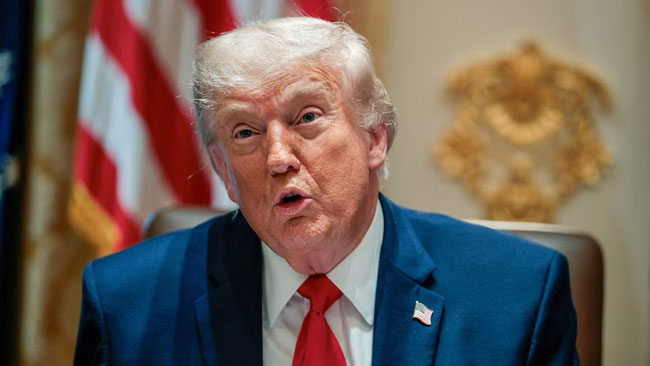
President Donald Trump signalled Friday that he is not yet ready to sign an agreement aimed at ending the conflict with Iran, despite a tentative outline reached on Thursday to reopen the Strait of Hormuz and begin nuclear negotiations, Ada Derana reported, citing wire services.
In a lengthy Truth Social post, Trump said he was meeting advisers in the White House Situation Room to “make a final determination” and laid out additional conditions for a final agreement. He demanded a commitment from Iran that it “never have a Nuclear Weapon or Bomb,” that the Strait of Hormuz be reopened “immediately” without tolls or restrictions on maritime traffic, and that Tehran complete “the immediate removal and/or detonation of any mines that are left, which will not be many.”
“Ships caught in the Strait due to our amazing and unprecedented Naval Blockade, which will now be lifted, may start the process of ‘heading home!’” Trump wrote, addressing crews and their families directly. He added that Iran’s stockpile of highly enriched uranium — a central concern for Washington — would be “unearthed by the United States” and destroyed by Iran, and that “no money will be exchanged, until further notice.” Other items “of far less importance, have been agreed to,” he said.
The intervention follows weeks of escalating tensions and intermittent clashes involving US and Iranian forces in the Persian Gulf, including US “self-defense” strikes near Bandar Abbas and Iranian retaliatory action. Treasury Secretary Scott Bessent had told reporters on Thursday that any final outcome “depends on what the president wants to do.” Vice-President JD Vance said negotiators were “very close” but “not there yet.”
Trump has also broadened his asking price for a regional deal, naming Saudi Arabia, Qatar, Pakistan, Turkey, Egypt and Jordan as countries that should “immediately” sign on to the Abraham Accords, the US-brokered framework launched during his first term to normalise diplomatic relations between Israel and several Arab states.
For Sri Lanka, whose fuel imports transit Hormuz and whose tourist arrivals have fallen for two consecutive months on the West Asia conflict, a Trump signoff would lift insurance and freight premiums that have driven up import costs and squeezed external accounts. A walk-back would prolong the squeeze.