The United States bombed Iranian radar and drone control sites at the weekend and Iran’s Islamic Revolutionary Guard Corps (IRGC) retaliated on Monday with a strike on a US base, the latest exchange of attacks under a fragile ceasefire that the two sides are trying to convert into a durable deal.
US Central Command said it carried out the strikes around the city of Geruk and on Qeshm Island in Iran’s Gulf coast on Saturday and Sunday, in response to Tehran’s shootdown of an American MQ-1 Predator drone operating over international waters. “US fighter aircraft swiftly responded by eliminating Iranian air defences, a ground control station, and two one-way attack drones that posed clear threats to ships transiting regional waters,” CENTCOM said. No US troops were hurt.
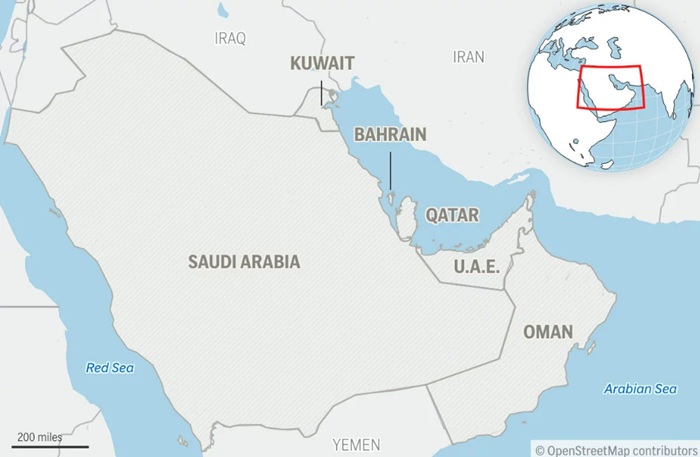
Kuwait said its air defences opened fire early Monday to intercept incoming drone and missile fire, with sirens sounding across the country, state news agency KUNA reported. The IRGC, citing the state-run IRNA agency, said US forces had targeted a telecommunications tower and that it had responded with an attack on a US base — almost certainly the strike on Kuwait, which hosts US Army Central, the Mideast forward command for the US Army.
Iranian state television later showed footage of the ballistic missile launch, including a close-up of a sticker on the body of the missile depicting a bruised US President Donald Trump overlaid on a “closed” Strait of Hormuz with the caption “Until the last American soldier leaves the region.”
Over the weekend the US also fired a missile into the engine room of a Gambia-flagged cargo ship attempting to break the American blockade of Iranian ports, Newswire reported, citing NPR and AP. Iran has maintained its chokehold on the Strait of Hormuz, through which a fifth of globally traded oil and gas once passed. A trickle of vessels has exited the strait, but the disruption continues to push up global energy prices and fertiliser costs.
Trump, in a Truth Social post early Monday in Washington, did not mention the exchange of strikes. He berated critics — including “seemingly unpatriotic Republicans” — for negative “chirping” about the negotiations, repeating that Iran “really wants to make a deal.” “Just sit back and relax, it will all work out well in the end — It always does!” he wrote. The US president faces pressure to reopen the Strait of Hormuz and bring down US gasoline prices ahead of the November congressional elections, while also navigating Iran hawks within his own party.
The new round of strikes follows the May 26 CENTCOM action that destroyed two mine-laying boats and a Bandar Abbas missile site, and comes as Trump is weighing a third round of edits to the May 28 framework covering Hormuz transit rules and Iran’s stockpile of highly enriched uranium. Israel’s renewed offensive in Lebanon — Prime Minister Benjamin Netanyahu has ordered troops deeper into Lebanon against Hezbollah — remains another impediment to any wider de-escalation, with US Secretary of State Marco Rubio in contact with both Lebanese President Joseph Aoun and Netanyahu on a “gradual de-escalation” plan.