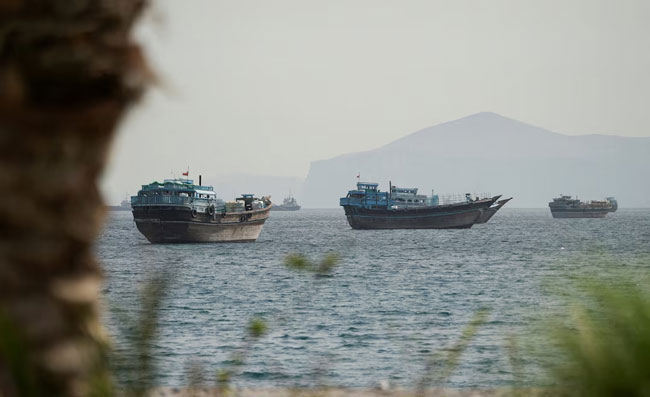
The first tankers carrying Middle East oil and liquefied natural gas have begun exiting the Strait of Hormuz since the war on Iran began, shipping data showed, in the clearest real-world sign yet that the vital waterway is reopening.
An LNG carrier was crossing the strait on Monday bound for Pakistan, while a supertanker loaded with Iraqi crude for China left the Gulf on Saturday after being stranded for nearly three months, Reuters reported via Ada Derana, citing ship-tracking data from LSEG and Kpler.
The Bahamas-flagged tanker Fuwairit, owned by Japan’s Mitsui O.S.K. Lines, loaded LNG at Qatar’s Ras Laffan port around March 28 and is expected to discharge in Pakistan on Tuesday. The Singapore-flagged supertanker Eagle Verona, chartered by Sinopec trading arm Unipec, loaded nearly two million barrels of Basrah crude around February 26 and is due at China’s Ningbo port on June 12.
The vessels are among a handful of supertankers leaving the Gulf this month via a transit route Iran has directed ships to use. Last week, three Very Large Crude Carriers carried six million barrels of crude to China and South Korea.
The US-Israeli war on Iran, which began on February 28, sharply curtailed traffic through Hormuz, the chokepoint for roughly one-fifth of the world’s oil and LNG supply. Before the war, the strait saw 125 to 140 daily passages. Some 20,000 seafarers remain stranded inside the Gulf aboard hundreds of ships.
The departures follow the framework under which President Trump said a deal had been “largely negotiated” and a reported 30-day restoration of pre-war Hormuz traffic. Earlier this month Iran’s foreign minister had declared the strait “fully open,” though actual transits stayed scarce. The disruption had driven UN warnings of a fertiliser and food-price crisis.
Source: Ada Derana / Reuters — Vessels carrying Middle East oil, LNG exit Hormuz.