Two of Sri Lanka’s largest consumer-facing groups reported September-quarter results showing the same pattern from opposite ends: strong sales growth, thinner margins, and a deliberate choice not to pass rising costs on to customers in full.
Cargills (Ceylon) PLC posted net profit of Rs. 3.01 billion, up 9.4% from Rs. 2.75 billion a year earlier, on revenue of Rs. 76.29 billion — a 16.2% rise, EconomyNext reported. Earnings per share rose to Rs. 11.80 from Rs. 10.83.
Hemas Holdings PLC grew revenue faster — up 17.0% to Rs. 37.79 billion — but net profit slipped 3.0% to Rs. 2.00 billion from Rs. 2.06 billion, EconomyNext reported. Earnings per share eased to Rs. 0.67 from Rs. 0.69. On the wider measure, total group profit for the period fell 1.7% to Rs. 2.12 billion.
| Cargills | Hemas | |
|---|---|---|
| Revenue | Rs. 76.29bn (+16.2%) | Rs. 37.79bn (+17.0%) |
| Net profit | Rs. 3.01bn (+9.4%) | Rs. 2.00bn (−3.0%) |
| Operating result | Rs. 5.59bn (+13.6%) | Rs. 3.78bn (+8.1%) |
| Net finance costs | Rs. 1.16bn (+22.3%) | Rs. 248.7mn (from Rs. 55.5mn) |
| Total assets | Rs. 148.94bn | Rs. 129.97bn |
| Net assets per share | Rs. 168.97 | Rs. 19.22 |
Volume, not price, drove Cargills
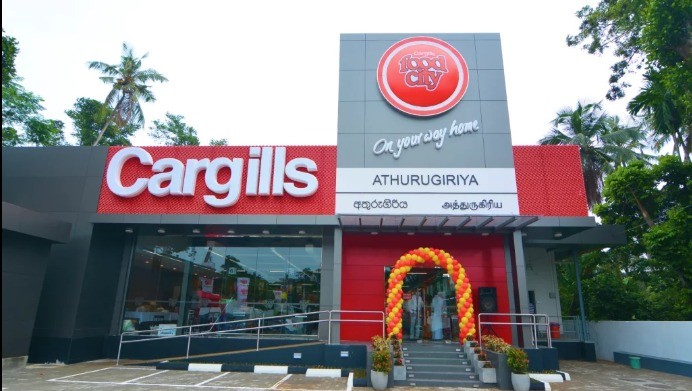
Growth came from all three Cargills pillars. Retail generated Rs. 54.77 billion, up 14.7%, on same-store sales growth of 13.2% across Cargills Food City, with the network reaching 564 stores after four openings in the quarter. The group attributed it to higher footfall and larger average baskets amid inflationary adjustments.
FMCG was the fastest-growing segment, up 20.4% to Rs. 17.44 billion, with operating profit climbing 27.4% to Rs. 2.61 billion on product mix and cost optimisation.
Restaurants told the opposite story. Revenue rose 19.0% to Rs. 4.07 billion on 17.4% same-store sales growth, with KFC adding six outlets to reach 97 — yet restaurant operating profit fell 4.0% to Rs. 685.4 million, which management put down to a measured approach to menu price revisions to protect affordability against steep operating cost increases.
Distribution expenses rose 20.3% to Rs. 2.99 billion and administrative expenses 10.7% to Rs. 2.14 billion on energy, personnel and logistics overheads. Cargills shares closed September at Rs. 675.00.
Hemas was squeezed from two directions
Hemas grew across every segment — Life Sciences, its largest, up 16.2% to Rs. 18.37 billion; Consumer Brands up 18.3% to Rs. 15.57 billion; Hospitals up 19.3% to Rs. 3.21 billion on higher admissions and channel consultations; Mobility up 3.7% to Rs. 646 million.
But cost of sales grew faster than revenue, at 22.5%, holding gross profit growth to 5.8% and contracting the gross margin by 3.1 percentage points to 29.7%. The group said it chose to absorb higher input, energy and logistics costs arising from the Middle East conflict rather than pass them entirely to consumers. Price recovery was further constrained in regulated pharmaceuticals, where revision mechanisms under the National Medicines Regulatory Authority faced delays.
The sharper hit was below the operating line. Finance costs surged 149.4% to Rs. 464.3 million as short-term borrowings funded inventory ahead of the school season, extended distributor credit, and the group’s Kenyan acquisition. The quarter included the first consolidation of Twiga Stationers & Printers, the East African learning-solutions business in which Atlas Axillia took a 75% stake in August, adding Rs. 1.40 billion in provisional goodwill.
Hemas declared an interim dividend of Rs. 0.25 per share, payable on or before 4 December. Its shares closed September at Rs. 31.00.
The common thread
Both groups grew volumes strongly while declining to price at full cost recovery — Cargills in restaurants, Hemas across consumer and pharmaceutical lines. That restraint is visible in the margins of both.
It sits alongside separate official data published the same week showing the average household now retains about Rs. 4,000 a month after spending, down from more than Rs. 13,000 in 2019 — the demand-side condition these pricing decisions are being taken against.
Not reported
Neither filing gives segment-level margins for Cargills, a breakdown of the Middle East cost impact at Hemas, or any management guidance for the remainder of the financial year. Neither reports board commentary beyond the stated attributions, and neither gives the Twiga contribution to Hemas revenue separately from the group total.
Both accounts come from a single verified newsroom; no second verified outlet reachable from this desk had filed on either set of results at the time of writing.