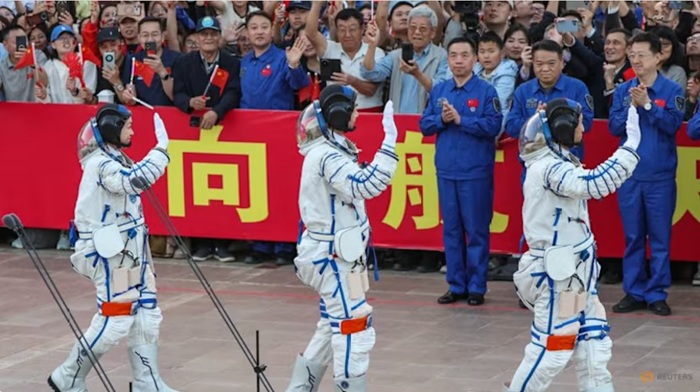
China sent three astronauts to its Tiangong space station on Sunday, with one crew member scheduled to remain for a full year — a record duration for a Chinese astronaut and a step toward Beijing’s ambition of landing humans on the Moon by 2030.
The Shenzhou-23 spacecraft lifted off at 11:08 p.m. (1508 GMT) aboard a Long March-2F Y23 rocket from the Jiuquan Satellite Launch Center in northwest China. The crew comprises commander Zhu Yangzhu and pilot Zhang Yuanzhi, both from the People’s Liberation Army’s astronaut division, and payload specialist Li Jiaying — a former Hong Kong police inspector and the first astronaut from the city to fly on a Chinese mission.
The year-long stay, to be assigned to one crew member later in the mission, is among the longest in history but short of the 14-and-a-half-month record set by a Russian cosmonaut in 1995. The China Manned Space Agency said the extended deployment will let scientists study radiation exposure, bone-density loss and psychological stress over a longer period.
The launch comes amid an accelerating Moon race with the United States. NASA is targeting a crewed lunar landing in 2028, two years ahead of China, and last month flew four astronauts around the Moon on its Artemis II mission. A successful Chinese landing before 2030 would underpin plans for a permanent lunar base by 2035, to be built with Russia.
Shenzhou-23 will also perform an autonomous rapid rendezvous and docking with Tiangong’s core module, rehearsing manoeuvres central to the 2030 plan. The flight follows last week’s largely successful uncrewed test of SpaceX’s next-generation Starship and NASA’s Artemis II crew return.