A historically powerful earthquake struck off Cuba’s northwest coast on Monday, with the U.S. Geological Survey (USGS) recording it at magnitude 6.1 at a shallow depth of 26 km. The epicentre was located 104 km west-northwest of Mantua — between two and four hours by car from the capital, Havana.
USGS seismologist Paul Earle said the quake was unusual because it occurred within a tectonic plate rather than along a plate boundary, where Caribbean tremors are typically more scattered and less frequent. No earthquake of comparable strength had struck within 322 km of Monday’s epicentre since 1880, when a 6.0 tremor hit near San Cristobal, Cuba.
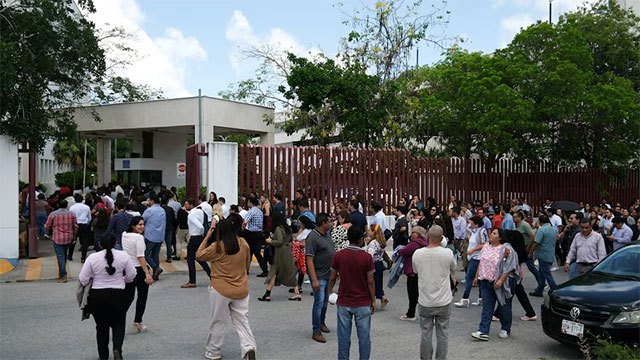
Shaking was felt across parts of Florida and in Mexico’s Yucatan peninsula tourist hubs of Cancun, Playa del Carmen and Tulum. Residents and workers in Cancun’s city centre, unaccustomed to strong quakes, evacuated buildings. Emergency protocols were activated in Mexico’s Yucatan and Quintana Roo states, though neither state’s governor reported damage on social media. The U.S. National Weather Service issued no tsunami warning or watch.
Authorities had not reported major casualties or structural damage by Tuesday, but concern remained high in Cuba, where decades of economic crisis have left buildings in severe disrepair and ongoing widespread blackouts hampered communications.
“It felt strong. I had never felt anything like that,” said Yusmila Hernandez, 44, at her home in Pinar del Rio in western Cuba. “People ran outside, everyone scared. I can’t even explain it. It felt like no earthquake has ever felt here before.”
The Cuban tremor comes one day after a magnitude 7.8 earthquake struck off the Philippines, prompting a brief tsunami warning in Mindanao, and as the Pacific region has seen elevated seismic activity through 2026 including the Iwate-Hokkaido mega-quake sequence in Japan.
Source: Reuters via Ada Derana.