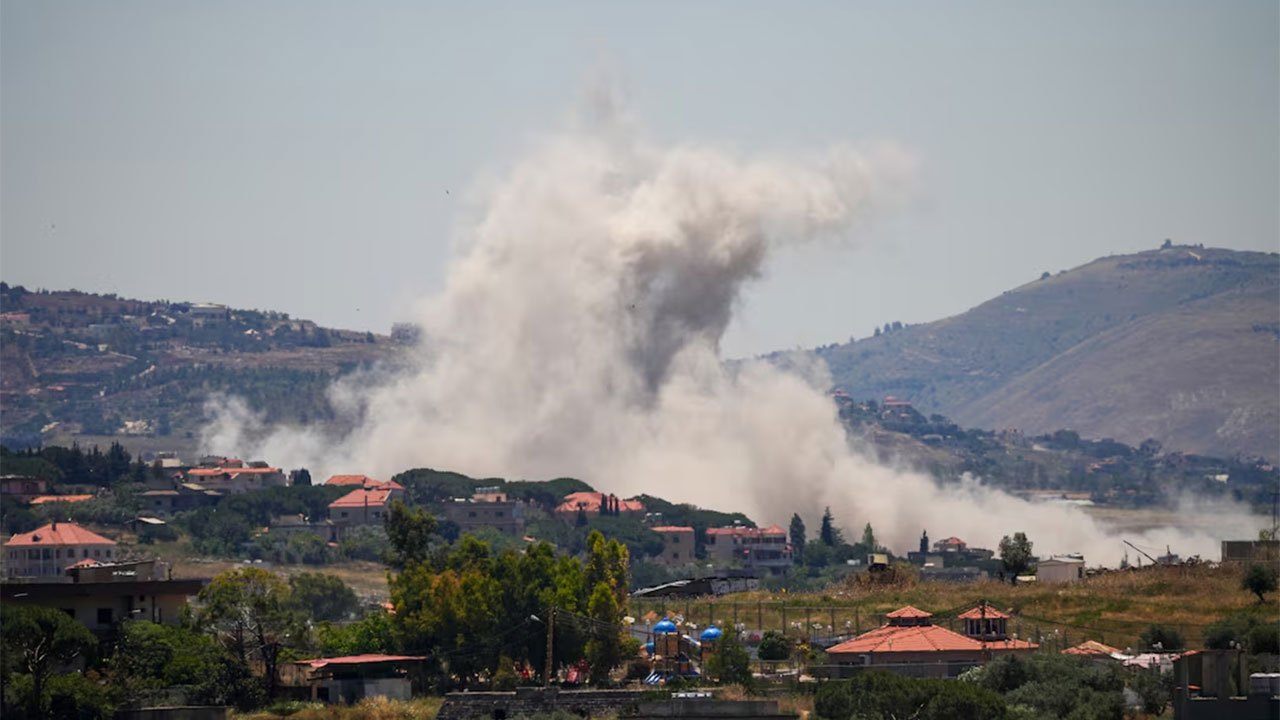
Hezbollah leader Naim Qassem on Thursday rejected the Washington-brokered Lebanon ceasefire announced a day earlier, insisting that “resistance will continue” and undermining US President Donald Trump’s effort to halt fighting in Lebanon as a stepping stone to ending the wider war with Iran, Ada Derana reported, citing Reuters.
Israel said in parallel that it would not withdraw troops from southern Lebanon or stop its operations. Defence Minister Israel Katz confirmed Israeli forces would remain in the country they invaded in March alongside the war on Iran, and Israeli strikes continued in the south on Thursday. Lebanese President Joseph Aoun had said earlier that the ceasefire would come into force within 24 hours of all parties signing off, but Hezbollah — not party to the US-brokered Israel-Lebanon deal — was required to halt attacks for it to hold.
The commander of Iran’s Revolutionary Guards Quds Force, which established Hezbollah in 1982, said the “minimum demand of the resistance” was Israel’s withdrawal to positions held before the war began. “Our initial condition for accepting a ceasefire in the regional war was a ceasefire on all fronts, including Lebanon,” a separate IRGC statement carried by Iranian state media said. Tehran has made a Lebanon ceasefire a precondition for any peace deal with Washington and has hinted in recent days at direct intervention if Israel escalates further.
The rejection came against the backdrop of a sharp Gulf flare-up. Iranian and US forces traded attacks on Wednesday in one of the most intense bouts of fighting since the early-April ceasefire that paused large-scale bombing of Iran. Iranian forces struck Kuwait, damaging the airport and injuring dozens, while the US military carried out strikes near the Strait of Hormuz and on Qeshm Island. The Strait — through which roughly a fifth of global oil and LNG normally flow — remains largely closed more than three months after the US-Israeli bombing campaign began.
Oil prices fell about 3 percent on Thursday on hopes that a Lebanon ceasefire could still open a diplomatic off-ramp. Speaking at the White House on Wednesday, Trump suggested progress with Iran could come “over the weekend” and said negotiators were working to separate the issue of reopening Hormuz from the Lebanon track. Iran’s Supreme Leader Ayatollah Mojtaba Khamenei — who has not appeared in public since succeeding his father after the airstrike at the start of the war — said Iran’s enemies had already been defeated militarily and were now sowing internal divisions.
The breakdown comes a day after the US State Department said Israel and Lebanon had agreed to implement the ceasefire, contingent on a full Hezbollah halt and the group’s evacuation from a southern strip. It supersedes the partial pause announced on Monday under which Israel agreed not to bomb Beirut in exchange for Hezbollah halting its strikes, and follows the Kuwait airport attack that injured three Sri Lankans on the same Wednesday escalation. Sri Lanka’s diesel pump price and rupee remain under pressure from the Hormuz closure, with the monthly fuel import bill having hit USD 886 million in April. Iran is also seeking access to billions in frozen oil revenue, sanctions waivers on crude exports and a lifting of the US blockade on its ports as part of any wider settlement, the Ada Derana report said.