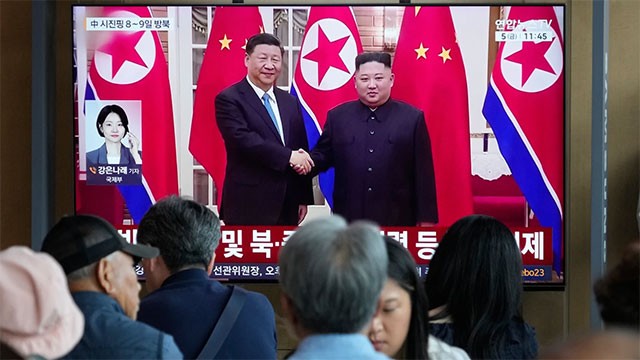
Chinese President Xi Jinping will make a state visit to North Korea next Monday and Tuesday, in his first trip to the country in nearly seven years, both Beijing and Pyongyang said on Friday, Ada Derana reported, citing the Associated Press.
State media in China and the Democratic People’s Republic of Korea issued brief dispatches confirming the visit but did not release a detailed agenda. Xi’s last visit to North Korea was in June 2019.
The trip is widely read by analysts as a Chinese effort to reassert influence over its nuclear-armed neighbour, whose leader Kim Jong Un has spent the past two years deepening ties with Russia — including by deploying troops and supplying conventional weapons for Moscow’s war in Ukraine. Kim has more recently rebalanced toward Beijing, North Korea’s largest trade partner and aid provider.
“As North Korea builds closer ties with Russia, China seeks to use Xi’s trip to reassert its influence over Pyongyang and safeguard its strategic interests in northeast Asia,” William Yang, an analyst at the International Crisis Group, was quoted by AP as saying.
The Xi visit will come weeks after the Chinese leader hosted U.S. President Donald Trump and Russian President Vladimir Putin in Beijing in quick succession last month. It also follows North Korea’s unveiling — one day before the visit announcement — of what South Korea’s military has assessed to be a new uranium enrichment facility.
During a visit to the plant, Kim announced plans to bolster North Korea’s nuclear forces “at an exponential rate”. Analysts cited by AP said the timing implied Kim was seeking to entrench Pyongyang’s status as a nuclear-weapons state ahead of the Xi visit, with the longer-term aim of pressing the United States into arms-reduction talks rather than denuclearisation.
Kim has continued to expand the country’s nuclear arsenal since the collapse of his high-stakes Trump-era diplomacy in 2019. Trump has repeatedly signalled a wish to revive that engagement, but Kim has insisted that the US first drop its denuclearisation demand. Xi and Kim met in Beijing in September and pledged mutual support and enhanced cooperation; at last month’s bilateral meeting in the Chinese capital, Putin and Xi jointly opposed “foreign policy isolation, economic sanctions, military pressure and other methods of creating threats to the security” of North Korea, according to the Kremlin.
The visit is the latest signal of an emerging China–Russia–DPRK alignment that has frustrated US-led efforts to tighten sanctions over Pyongyang’s banned weapons tests. Sri Lanka and other Indian Ocean economies have watched the nuclear-program escalation closely since North Korean missile launches were tied to wider Iran-war context earlier this year.
Update — June 8: Xi arrived in Pyongyang on Monday for the two-day state visit, his entourage including his wife Peng Liyuan, Foreign Minister Wang Yi, and Politburo Standing Committee member Cai Qi, the Newswire and AP reported. Kim and his wife Ri Sol-ju personally welcomed the Chinese delegation at the airport, and a welcome ceremony was held at Kim Il Sung Square. Portraits of Xi and flags of both nations lined the streets in preparation for the visit. The trip carries symbolic weight: this year marks the 65th anniversary of the Treaty of Friendship, Cooperation and Mutual Assistance between Pyongyang and Beijing. One day before Xi’s arrival, Kim’s sister Kim Yo-jong declared the country’s nuclear status “absolutely irreversible”, calling it a “line of no retreat” — Pyongyang’s strongest public restatement of its nuclear posture ahead of the talks. Last month, North Korean troops marched alongside Russian forces in Moscow’s Victory Day parade for the first time, underscoring the deepening Pyongyang-Moscow alignment that Beijing’s diplomacy is now attempting to rebalance.
Update — June 9: Xi concluded the visit on Tuesday, saying it had established “a deeper, more comprehensive understanding” and a “clearer” path for future ties, the official Xinhua news agency reported. KCNA said Xi and Kim agreed to expand cooperation across politics, economy and culture, and to maintain closer strategic communication through visits by high-level officials. Kim was filmed waving as Xi’s plane taxied for departure, after road-side crowds waved flags and shouted friendship slogans. Both leaders jointly planted a fir tree at a party-cadre training school as a symbol of “ever-renewing friendship”, and Xi also visited Pyongyang’s Sino-Korean Friendship Tower commemorating Chinese soldiers who died in the Korean War. Kim publicly endorsed the “One China principle” and said he would support it “regardless of changes in the international situation”. Analysts cited by Ada Derana saw contrasting priorities in the two sides’ communiqués: Xinhua emphasised practical state-to-state ties, trade, agriculture and transport-link restoration, while KCNA cast the summit as a pact of equal partners stressing “regime dignity” and the “special relationship”. Hong Min, a senior research fellow at the Korea Institute for National Unification, said Pyongyang had “rewrote the relationship as one between equals”, amplifying anti-US and Taiwan-related signals while removing markers of dependence.
Sources
- Chinese leader Xi Jinping will travel to North Korea next week in first visit since 2019 — Ada Derana / AP, June 5
- China’s Xi Jinping arrives in North Korea on first visit in 7 years — Newswire, June 8
- China’s Xi arrives in North Korea to meet Kim — NewsFirst, June 8
- China’s Xi hails deeper understanding at end of North Korea summit — Ada Derana, June 9