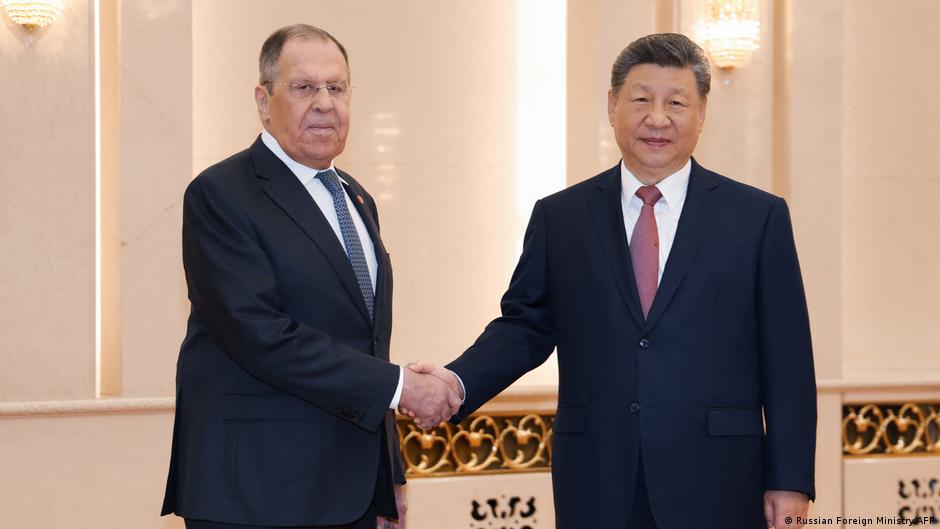
Chinese President Xi Jinping met Russian Foreign Minister Sergei Lavrov in Beijing on Wednesday, describing relations between the two countries as “precious” and calling for deeper cooperation as global leaders turn to China amid the Iran war.
Xi emphasised the significance of the friendship treaty between Beijing and Moscow, saying both sides should strengthen coordination and defend shared interests, Chinese state media reported.
Lavrov used the visit to publicly offer Russian help in boosting energy supplies to China and to other countries affected by disruptions to Gulf shipping, including constraints on transit through the Strait of Hormuz.
“Russia can, of course, make up for the resource shortfall facing both China and other countries that are interested in working with us on an equal and mutually beneficial basis,” Lavrov told a news conference.
The meeting is part of a wave of high-level diplomacy flowing toward Beijing. Spanish Prime Minister Pedro Sanchez, Abu Dhabi’s Crown Prince Mohamed bin Zayed Al Nahyan and Vietnamese leader To Lam all met Xi this week. China has projected itself as a stabilising force and potential mediator in the Iran conflict, with Gulf states hoping Beijing’s leverage over Tehran can help bring Iran to the negotiating table.
“China has got leverage and influence over Iran, and there are some hopes and expectations that China can use this influence in a more direct way,” Dylan Loh of Singapore’s Nanyang Technological University told AFP.
The Lavrov offer has direct implications for Sri Lanka, which is already negotiating a political-level deal with Moscow for oil supplies to help cover Middle East shortfalls. A broader Russia-China energy alignment would expand the discounted-crude pool Colombo may tap, though Washington’s sanctions waiver regime remains the binding constraint.
On Thursday, Chinese Foreign Minister Wang Yi followed up with a direct call to Iran’s Abbas Araghchi, urging that reopening Hormuz was a “unanimous demand” of the international community.