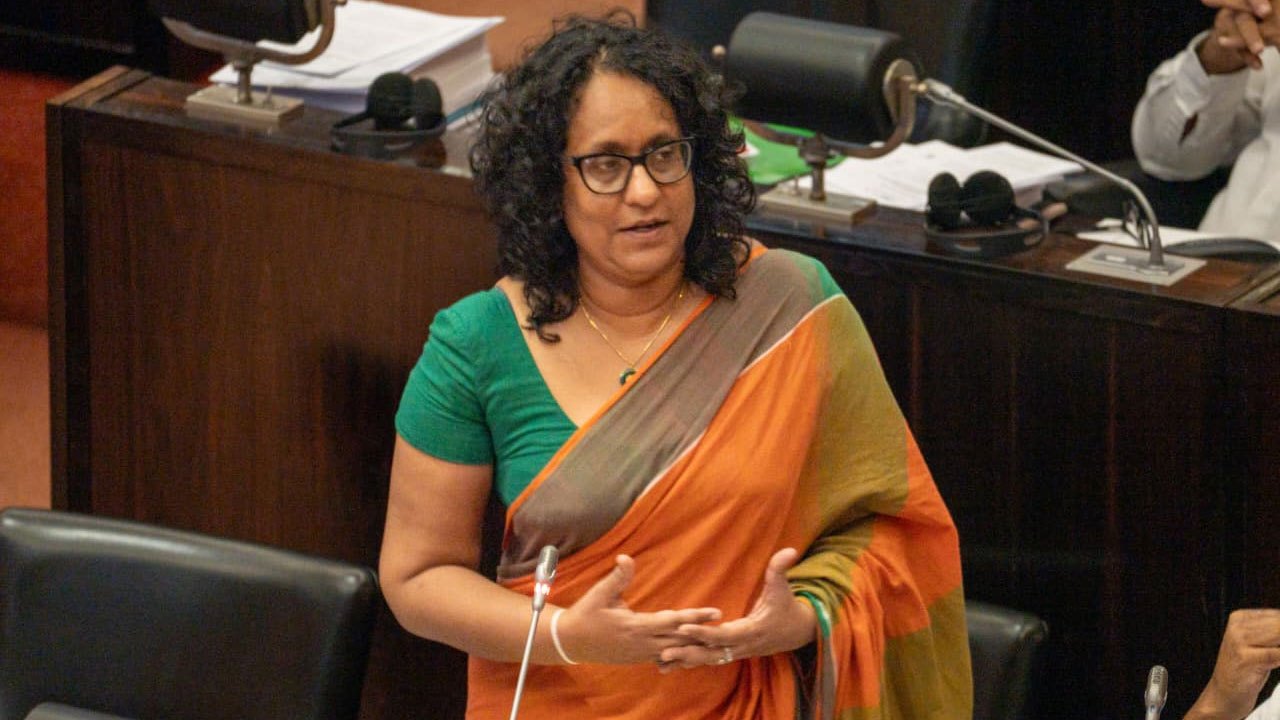
Prime Minister Harini Amarasuriya told Parliament on Wednesday that the government will introduce energy storage systems to maximise the utilisation of renewable energy as Sri Lanka works towards generating 70 percent of national electricity from renewable sources by 2030, Ada Derana reported.
Amarasuriya was responding to a question raised by MP Asitha Niroshana Egoda Vithana, according to a statement from the Prime Minister’s Media Division. She said the necessary plans had already been formulated and were being implemented to reach the 2030 target.
Under the Sri Lanka Sustainable Energy Authority’s Renewable Energy Development Plan 2025–2030, the Prime Minister said arrangements have been made to integrate larger volumes of renewable capacity into the national grid through various procurement mechanisms and the long-term generation expansion plan. The plan envisages 1,264 MW of wind and 2,071 MW of solar generation capacity.
Measures are also being taken to expand the national transmission and distribution network to facilitate integration of renewable energy, the statement said. Studies are currently under way to enhance the installed capacity of the country’s existing hydropower plants.
Energy storage will be introduced “as an important initiative of the Government” to optimise the absorption, storage and utilisation of renewable energy, Amarasuriya added.
The 70-percent-by-2030 target sets a hard policy anchor for several active investments. The 80 MW second BESS shipment that arrived at Colombo Port on May 31 and the 2,241-tonne BESS project cargo handled at CICT on June 7 are the first physical commitments under the storage track, alongside the green hydrogen and ammonia RFI deadline extended to June 19. With 3,335 MW of wind-plus-solar capacity planned by 2030, the storage-integration question is now the binding constraint on how quickly the system can absorb intermittent generation.