The United States military says it has completed a third consecutive night of strikes on Iran, hitting six coastal locations as it presses a campaign to reopen shipping through the Strait of Hormuz. In a statement, US Central Command (CENTCOM) said it had “successfully struck” targets in Bushehr, Chah Bahar, Jask, Konarak, Abu Musa and Bandar Abbas, employing precision munitions against Iranian coastal defence systems, missile and drone sites and maritime capabilities. CENTCOM said the aim was to “further degrade Iran’s ability to attack commercial shipping” and noted that more than 50,000 US service personnel are currently deployed across the Middle East. Al Jazeera reported the latest wave began at 4:45pm ET on Monday, hours before a reinstated naval blockade of Iranian ports was due to take effect.
Iran’s Islamic Revolutionary Guard Corps (IRGC) says it has struck United States military bases in Kuwait and Bahrain, as Tehran’s foreign ministry warned that any country allowing its territory to be used against Iran could become a “legitimate target” — a sharp widening of the confrontation reignited over the Strait of Hormuz.
In statements carried by Iranian media on Monday (July 13), the IRGC said the attacks were part of the “second and third phases” of a retaliatory operation that remains ongoing. It claimed to have destroyed a Patriot air-defence system and fuel tanks at the Ali Al-Salem base in Kuwait, and a radar installation at the Ahmad Al-Jaber base. In Bahrain, the Guards said they hit a US drone command-and-control centre at the Sheikh Isa air base, along with helicopter maintenance facilities and a hangar for P-8 aircraft. The IRGC said its first phase had earlier targeted the Prince Hassan Air Base in Jordan with missiles and drones. The claims could not be independently verified.
Separately, Iran’s foreign ministry condemned the latest US strikes as a “flagrant violation” of the UN Charter and a breach of the June ceasefire, accusing Washington of undermining regional stability. “The territory or facilities of any country used to launch military attacks against Iran may be regarded as the origin of aggression and treated as a legitimate target for defensive operations by the Iranian armed forces,” the ministry said. It urged the UN Security Council to hold the United States accountable and criticised the UN Secretariat for what it called an inadequate response.
Tehran also rejected remarks by US President Donald Trump about recent talks in Muscat as “a complete lie,” saying the discussions had focused on managing the Strait of Hormuz and the security of shipping routes rather than the outcome Washington described.
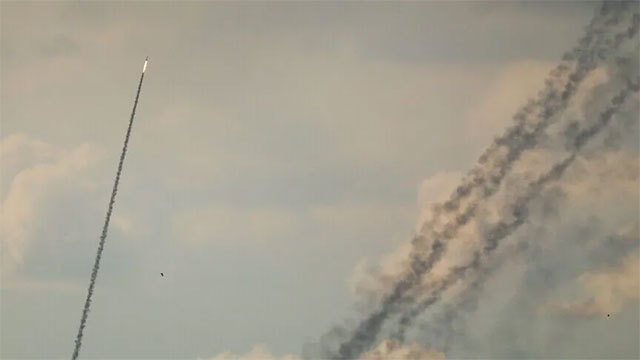
The exchanges follow a fresh US assault on Saturday that Washington said struck about 140 Iranian military targets — including missile and drone sites, naval assets, ammunition stores and coastal surveillance posts — with precision munitions launched from aircraft, drones and warships. US Central Command said the operation was intended to degrade Iran’s ability to target civilian mariners and commercial vessels in the Strait of Hormuz. Iran’s Press TV reported explosions in the southern cities of Jask, Bandar Abbas and Sirik.
The escalation began when the IRGC declared the Strait of Hormuz closed on Sunday after firing on a vessel, reviving fears for Sri Lanka’s fuel supply. A large share of the island’s fuel imports transit the strait, and a prolonged closure in June pushed up Ceylon Petroleum Corporation costs and forced QR-based fuel rationing. Sri Lankan energy authorities had not issued a statement at the time of writing.