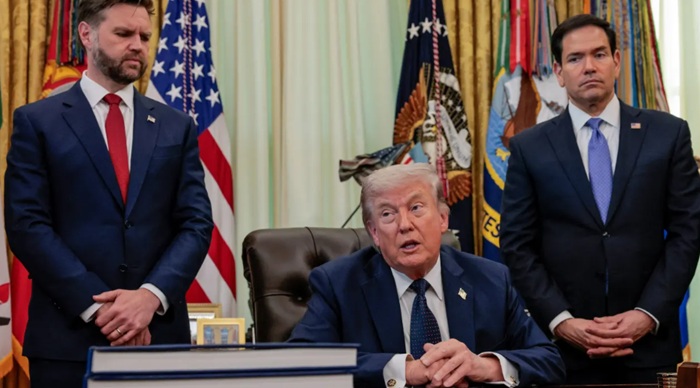
US President Donald Trump said a deal between Israel and Iran is close and that the Strait of Hormuz could reopen within two to three days once an agreement is signed, in fresh comments to reporters late Monday that put a tighter timetable on the de-escalation track than his earlier “total victory in two weeks” framing.
Speaking to reporters, Trump said the United States was in the “final throes” of what he described as a “very, very good deal”, Newswire reported. He suggested Israel and Iran may refrain from further attacks for at least a week, following the weekend’s most serious escalation since the April ceasefire.
Trump said continued US pressure — including a naval blockade of Iranian ports — was pushing Tehran towards an agreement, claiming military strikes alone would not achieve the same outcome. In comments to Axios, he said he had warned Israeli Prime Minister Benjamin Netanyahu over the continuation of the conflict, telling him he could soon be “on your own”. On his Truth Social platform, the president urged both sides to stop “shooting” and said final negotiations were under way, warning progress could be derailed by “ignorance or stupidity”.
The remarks layer onto the tele-rally appearance hours earlier in which Trump predicted Washington would declare “total victory” over Iran within two weeks. The newer two-to-three-day Hormuz framing is the sharpest specific timetable he has set for the chokepoint, where Tehran has blocked most commercial shipping and where any reopening would directly ease the war-risk premium driving Sri Lanka’s crude bill — which surged to US$886 million in April, the highest single-month reading of the cycle.
The “on your own” warning to Netanyahu is the sharpest public US-Israel friction signal since Trump rebuked the Israeli leader by phone on Sunday and told him not to strike back after Iran’s Ramat David missile barrage. It also comes after Iran’s Khatam al-Anbiya command formally suspended operations against Israel on Monday — the de-escalation pivot of the Beirut-strike retaliation cycle — and amid the June 7 US move to redirect frozen Iranian assets to Gulf reconstruction, which Tehran rejected.
The renewed violence on Sunday — triggered by Israeli strikes on Beirut — saw Iran respond with missile attacks on northern Israel, while Israel later struck Iranian air defence systems and a petrochemical facility. Iran also hit a facility in Haifa and targeted Israeli airbases. No deaths have been reported in those exchanges.