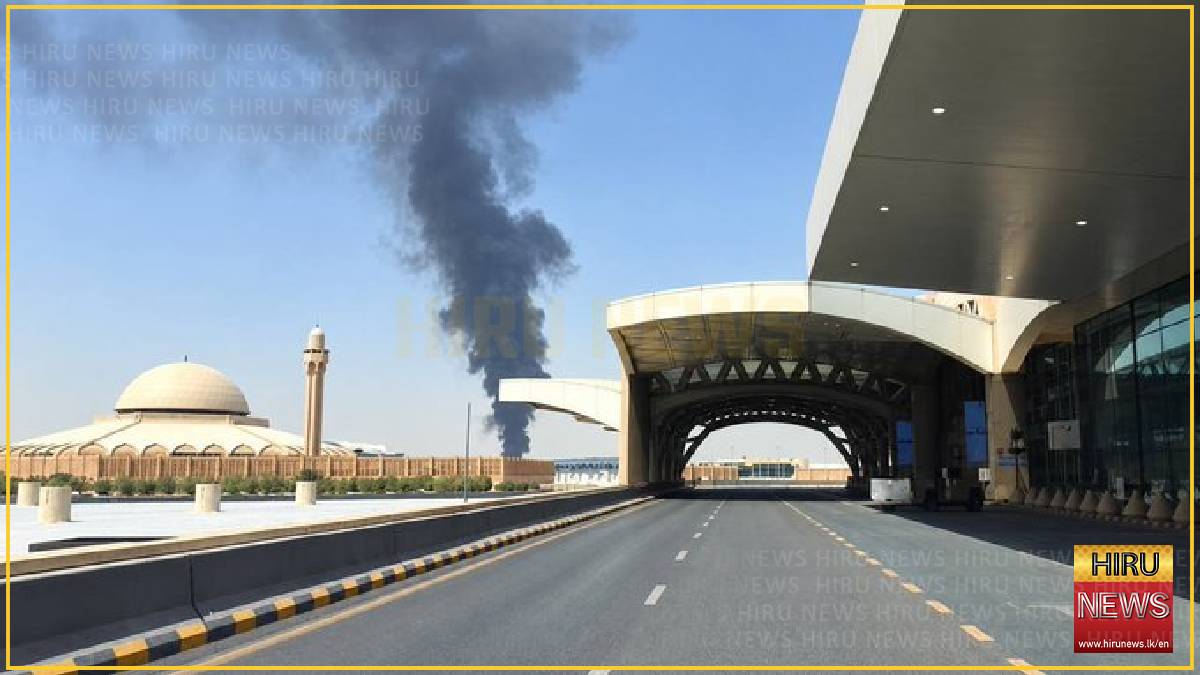
A ballistic missile fired at Riyadh at dawn on Saturday was intercepted and destroyed, the Saudi-led coalition said, hours before a large column of black smoke was seen rising near King Khalid International Airport in the Saudi capital, Al Jazeera reported.
Coalition spokesperson Major-General Turki al-Maliki said the Iran-aligned Houthi group fired the missile before it was brought down, and that further attempts to target civilians in Bisha, Taif, Farasan and Yanbu were “thwarted by the Gulf monarchy’s air defences.” Saudi authorities reported no casualties or damage.
Reuters footage carried by the Daily Mirror showed a pillar of black smoke rising with the airport highway, main terminal building and other facilities in the foreground. At one point in the video, flames were visible rising from behind what appeared to be fuel tanks.
The one thing none of the three reports explains
The gap in this story is the cause of the fire.
If the missile aimed at Riyadh was destroyed before impact, and Saudi authorities say there was no damage, then the burning fuel installation beside the kingdom’s main airport has no stated source. Al Jazeera does not say what caused the plume. The Daily Mirror’s Reuters wire says the cause “was not immediately clear.” Hiru News, relaying India Today, says the same and adds that Saudi government media officials did not respond to a request for comment.
Falling interceptor or missile debris would be the obvious explanation, but no outlet offers it and none should be read as implying it. As of publication the fire and the official account of an intercepted missile causing no damage have not been reconciled by anyone.
The alerts reached the capital for the first time since July
Saudi civil defence sent phone alerts overnight warning of potential aerial attack danger in Riyadh and in Al-Kharj, which Reuters places east of the capital, before issuing an all-clear on Saturday morning. A Reuters journalist in Riyadh’s Olaya district heard booms before the all-clear was sent.
The Daily Mirror’s wire makes the significant point explicitly: although Riyadh saw some alerts earlier this year after the start of the US-Iran war, these were the first since the escalation with the Houthis began in July.
That is the development. Houthi fire on Saudi Arabia has until now concentrated on the south and west. On 15 September, when Sri Lanka’s Jeddah consulate issued an emergency advisory, the attacks that prompted it had wounded civilians in Khamis Mushait, Abha and Taif — all in the south-west. A week earlier, Houthi strikes on four Saudi cities wounded 73 people. Riyadh sits roughly 800 km north-east of the Yemeni border.
Sri Lankans in Riyadh have had no equivalent advisory. The Jeddah consulate’s notice was addressed specifically to the western region of the kingdom; Riyadh is in the central region and falls under the embassy rather than that consulate. No advisory covering the capital has been reported by any outlet. Saudi Arabia remains one of the largest destinations for Sri Lankan migrant labour, and the Jeddah advisory’s instructions — move indoors, away from windows, and do not photograph or film incidents — were framed around exactly the kind of alert Riyadh received on Friday night.
What the Houthis say
Houthi military spokesperson Yahya Saree said the group struck “sensitive” sites in Riyadh and an Aramco facility in Yanbu using “cruise and ballistic missiles as well as drones.” That claim and the coalition’s account of a single intercepted missile cannot both be complete descriptions of the same night.
On Friday, Saree had said the group foiled unspecified “criminal attempts” in the Yemeni capital Sanaa, blaming Saudi Arabia and vowing a response. The Houthis say the Saudi Air Force has conducted hundreds of airstrikes against them in recent days.
The group, which controls the most populous parts of Yemen and much of the north, has attacked Saudi Arabia since declaring a naval blockade against Riyadh in July, and seized Yemen’s entire Red Sea coast in an advance this month.
Condemnation, and the energy question
The UN Security Council said on Friday it condemned “in the strongest terms” continued Houthi attacks against Saudi Arabia, “including attacks impacting civilian and energy infrastructure, which have resulted in the injury of civilians, including women and children,” and also condemned “Houthi military escalation in Yemen.” Jordan called the attacks “a blatant violation” and expressed “absolute solidarity” with the kingdom. The UN Secretary-General and the GCC Secretary-General issued their own condemnations.
The strategic point in the Reuters wire matters for Sri Lanka. Houthi attacks on Saudi cities, energy infrastructure and shipping put at risk the Red Sea route that serves as the main alternative for Gulf exports — at a time when Strait of Hormuz traffic is under a US blockade regime. Sri Lanka imports effectively all of its fuel, and the Colombo bourse closed the week lower with analysts naming Middle East tensions and rising global oil prices as the cause.
Note that the same day this attack was reported, US Central Command said Hormuz shipping volumes had reached a six-month high — the two routes are moving in opposite directions.
Not reported
No outlet says whether flights at King Khalid International Airport were suspended or diverted, how long the fire burned, or whether it was extinguished. None reports the condition of the fuel installation.
None gives a casualty figure for the Yanbu Aramco facility the Houthis claim to have struck, and none says whether Saudi Arabia acknowledges that strike at all.