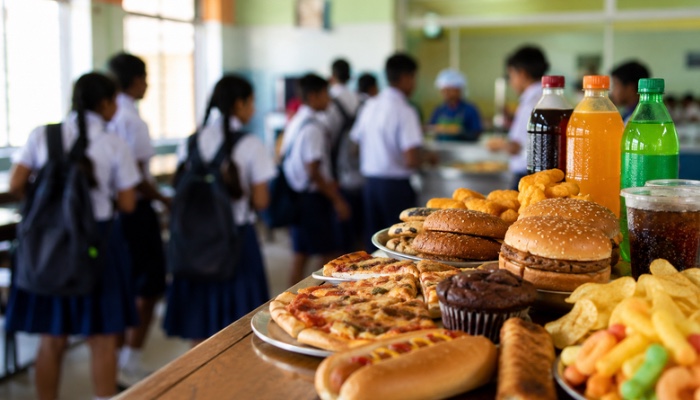
The Ministry of Health has formally issued a circular banning the sale of high-sugar, high-fat and processed food items in school canteens across the country, moving the long-flagged healthy canteen policy from intent to enforcement.
The banned items include hot dogs, burgers, pizzas, biscuits, cakes, carbonated drinks, extruded snacks and packaged beverages, Newswire reported. A guideline handbook has also been introduced to help schools regulate and monitor their canteens against the new rules.
Nutrition Division Specialist Dr Monika Wijeratne announced the circular at a media briefing at the Health Promotion Bureau on Sunday. The Ministry framed the measure as a direct response to a steady rise in overweight and obesity among schoolchildren documented in the 2024 Global School-based Student Health Survey, which found 12 percent of children aged 13 to 17 are overweight and 3 percent obese.
The same survey found 17.4 percent of school children consume carbonated drinks regularly, 28.5 percent eat foods high in salt, 29 percent eat high-fat foods and 41 percent eat foods high in sugar — figures the Ministry has flagged as a public-health concern for several months. NewsFirst noted that the majority of children consuming sugary drinks are boys.
The circular converts an earlier planning announcement from Dr. Wijeratne on June 16, when the joint MOH–Ministry of Education healthy canteen guideline was described as “being prepared”, into a binding administrative directive. It also lands alongside a broader Health Ministry push on youth lifestyle risks, including the June 15 World No Tobacco Day warning over a rapid spread of e-cigarettes among schoolchildren.
The new rules will overlay existing local-government policies such as the Colombo Municipal Council’s school canteen food policy adopted in May, and follow a year of political and parliamentary debate around school food, including an NPP MP proposal earlier in the year to ban high-calorie Sri Lankan staples like kottu and fried rice from canteens.
The circular does not yet specify enforcement penalties or a compliance window. Officials said effective monitoring of school canteens would be essential if the rules were to translate into measurable shifts in children’s daily nutrition.
The decision also has to sit alongside Sri Lanka’s wider “triple burden” of child malnutrition — undernutrition, micronutrient deficiency and rising overweight — which the Family Health Bureau flagged in May, and a 47 percent “nutrition paradox” in school-age children where some pupils are overweight while others remain underweight in the same classroom.